Kategorien
PEOPLE

Days like this

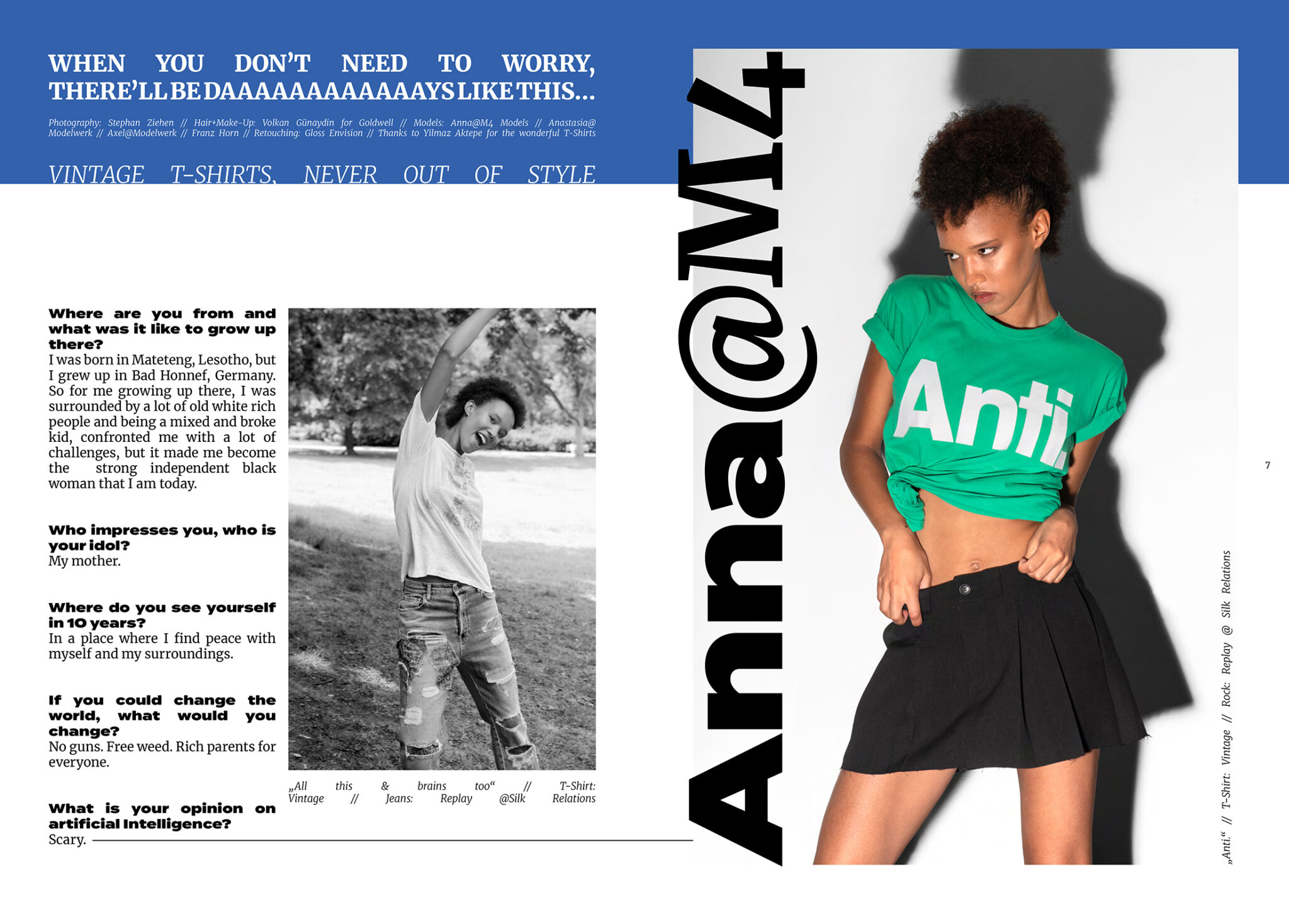
Anna@M4

Where are you from and what was it like to grow up there?

I was born in Mateteng, Lesotho, but I grew up in Bad Honnef, Germany.
So for me growing up there, I was surrounded by a lot of old white rich people
and being a mixed and broke kid, confronted me with a lot of challenges, but it made me become the strong independent black woman that I am today.

Who impresses you, who is your idol?

My mother.

Where do you see yourself in 10 years?

In a place where I find peace with myself and my surroundings.

If you could change the world, what would you change?

No guns.
Free weed.
Rich parents for everyone.


What is your opinion on artificial Intelligence?

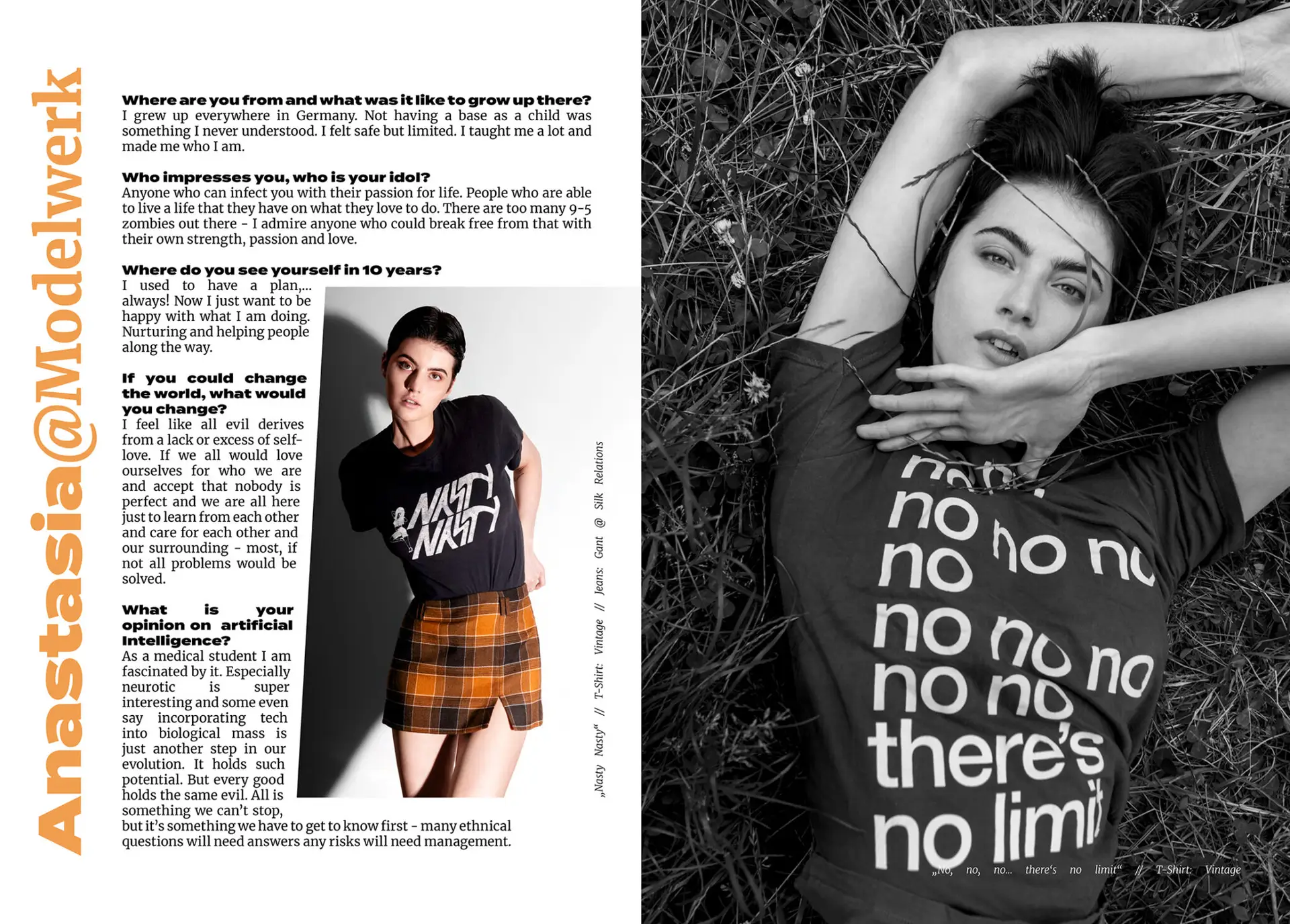
Anastasia@Modelwerk

Where are you from and what was it like to grow up there?

I grew up everywhere in Germany.
Not having a base as a child was something I never understood.
I felt safe but limited. I taught me a lot and made me who I am.

Who impresses you, who is your idol?

Anyone who can infect you with their passion for life.
People who are able to live a life that they have on what they love to do.
There are too many 9-5 zombies out there – I admire anyone who could break free from that with their own strength, passion and love.

Where do you see yourself in 10 years?

I used to have a plan,…always!
Now I just want to be happy with what I am doing.
Nurturing and helping people along the way.

If you could change the world, what would you change?

I feel like all evil derives from a lack or excess of self-love.
If we all would love ourselves for who we are and accept that nobody is perfect
and we are all here just to learn from each other and care for each other and our surrounding – most, if not all problems would be solved.

What is your opinion on artificial Intelligence?

As a medical student I am fascinated by it.
Especially neurotic is super interesting and some even say incorporating tech into biological
mass is just another step in our evolution.
It holds such potential. But every good holds the same evil.

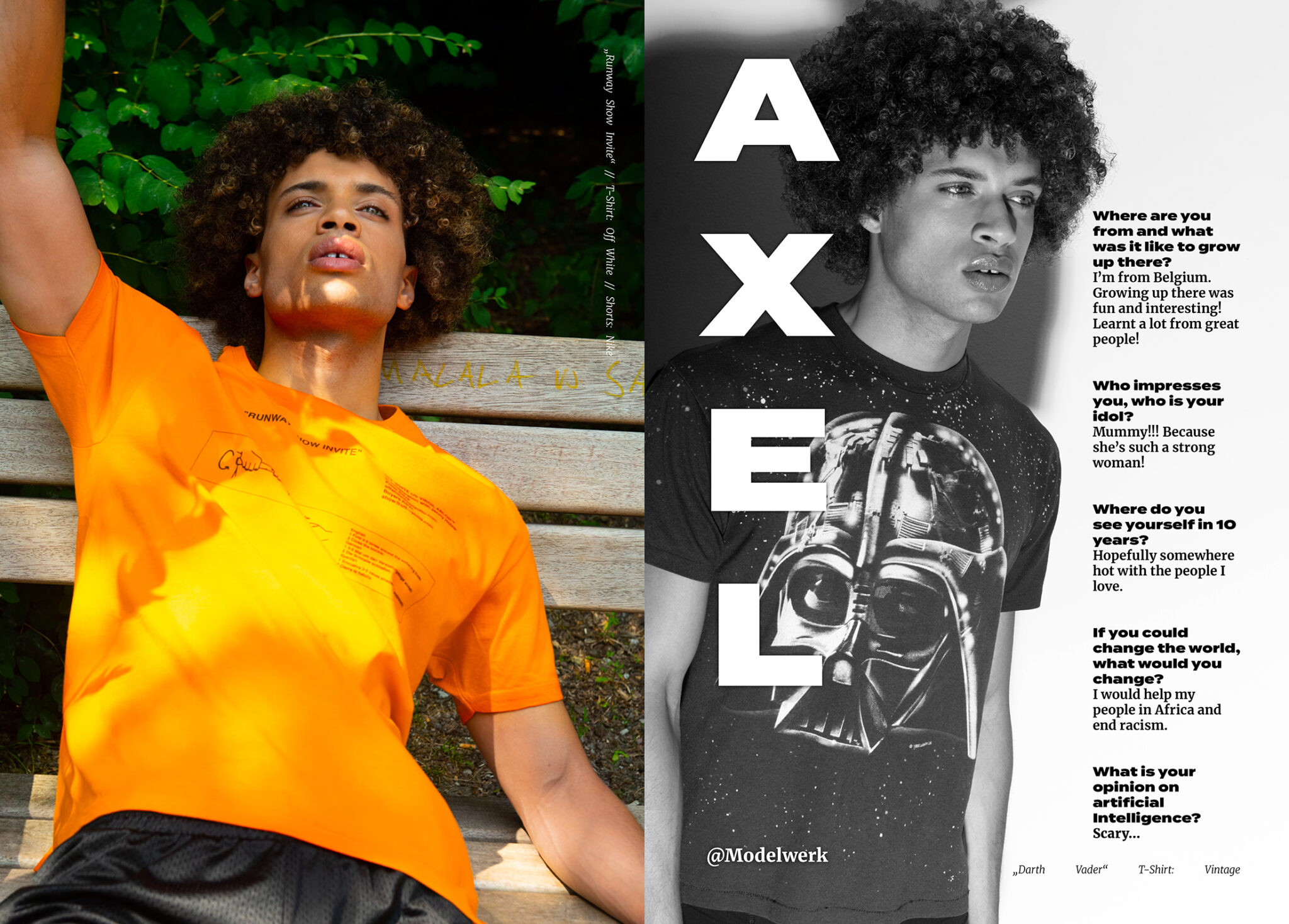
Axel@Modelwerk

Where are you from and what was it like to grow up there?

I’m from Belgium. Growing up there was fun and interesting!
Learnt a lot from great people!

Who impresses you, who is your idol?

Mummy!!! Because she’s such a strong woman!


Where do you see yourself in 10 years?

Hopefully somewhere hot with the people I love.

If you could change the world, what would you change?

I would help my people in Africa and end racism.

What is your opinion on artificial Intelligence?

Scary…

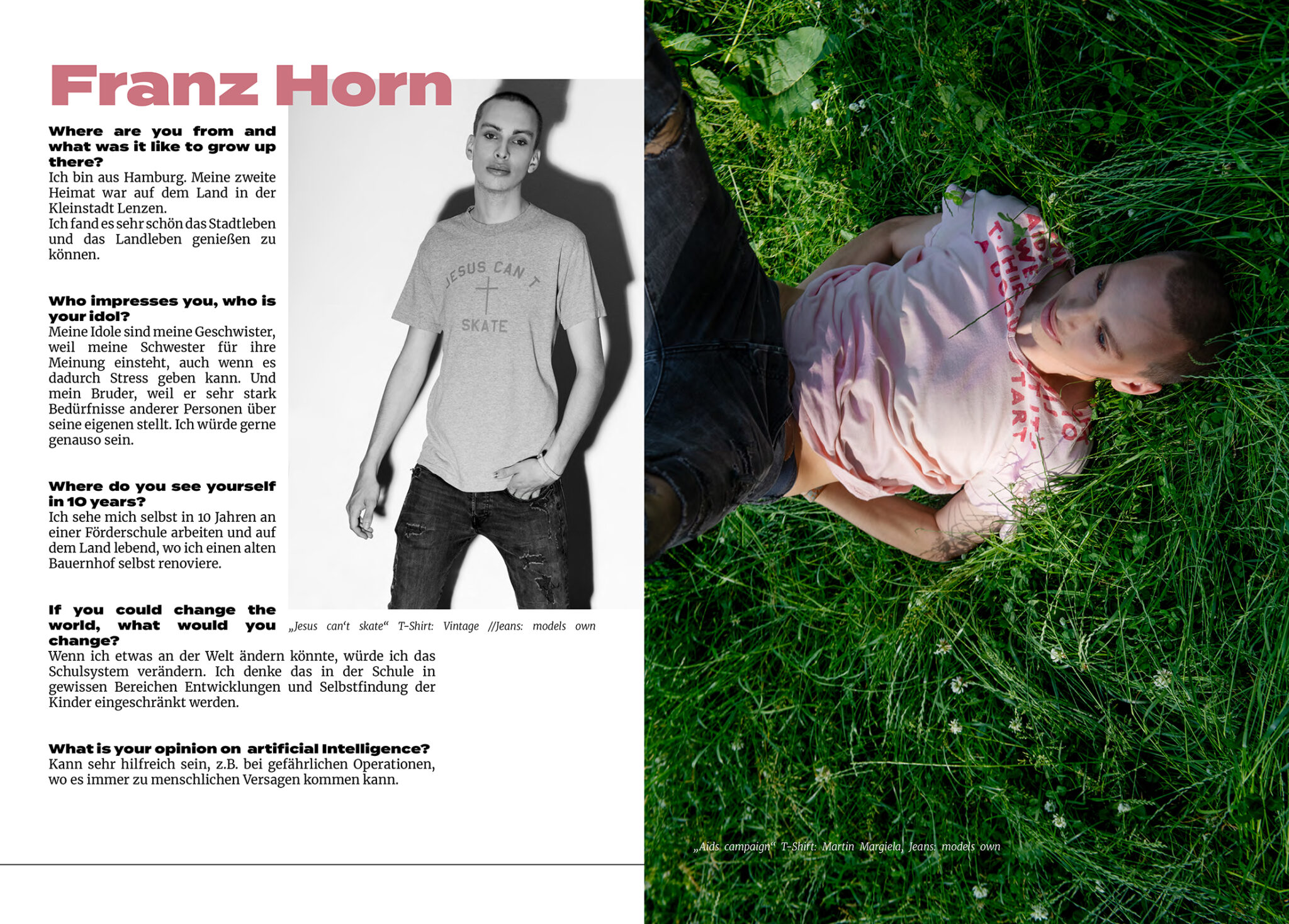
Franz Horn(ohne Agentur)

Where are you from and what was it like to grow up there?

Ich bin aus Hamburg. Meine zweite Heimat war auf dem Land in der Kleinstadt Lenzen.
Ich fand es sehr schön das Stadtleben und das Landleben genießen zu können.

Who impresses you, who is your idol?

Meine Idole sind meine Geschwister, weil meine Schwester für ihre Meinung einsteht, auch
wenn es dadurch Stress geben kann. Und mein Bruder, weil er sehr stark Bedürfnisse anderer Personen über seine eigenen stellt. Ich würde gerne genauso sein.

Where do you see yourself in 10 years?

Ich sehe mich selbst in 10 Jahren an einer Förderschule arbeiten und auf dem Land lebend, wo ich einen alten Bauernhof selbst renoviere.

If you could change the world, what would you change?

Wenn ich etwas an der Welt ändern könnte, würde ich das Schulsystem verändern. Ich denke das in der Schule in gewissen Bereichen Entwicklungen und Selbstfindung der Kinder eingeschränkt werden.

What is your opinion on artificial Intelligence?

Kann sehr hilfreich sein, z.B. bei gefährlichen Operationen, wo es immer zu menschlichen Versagen kommen kann.

Photograph: Stephan Ziehen
Hair+Make-Up: Volkan Günaydin for Goldwell
Models: Anna@M4 Models
Anastasia@Modelwerk
Axel@Modelwerk
Franz Horn

Retouching: Gloss Envision

Thanks to Yilmaz Aktepe for the wonderful T-Shirts

Kategorien
PEOPLE

Just Phriends

JUST PHRIENDS:Pharell goes fashion

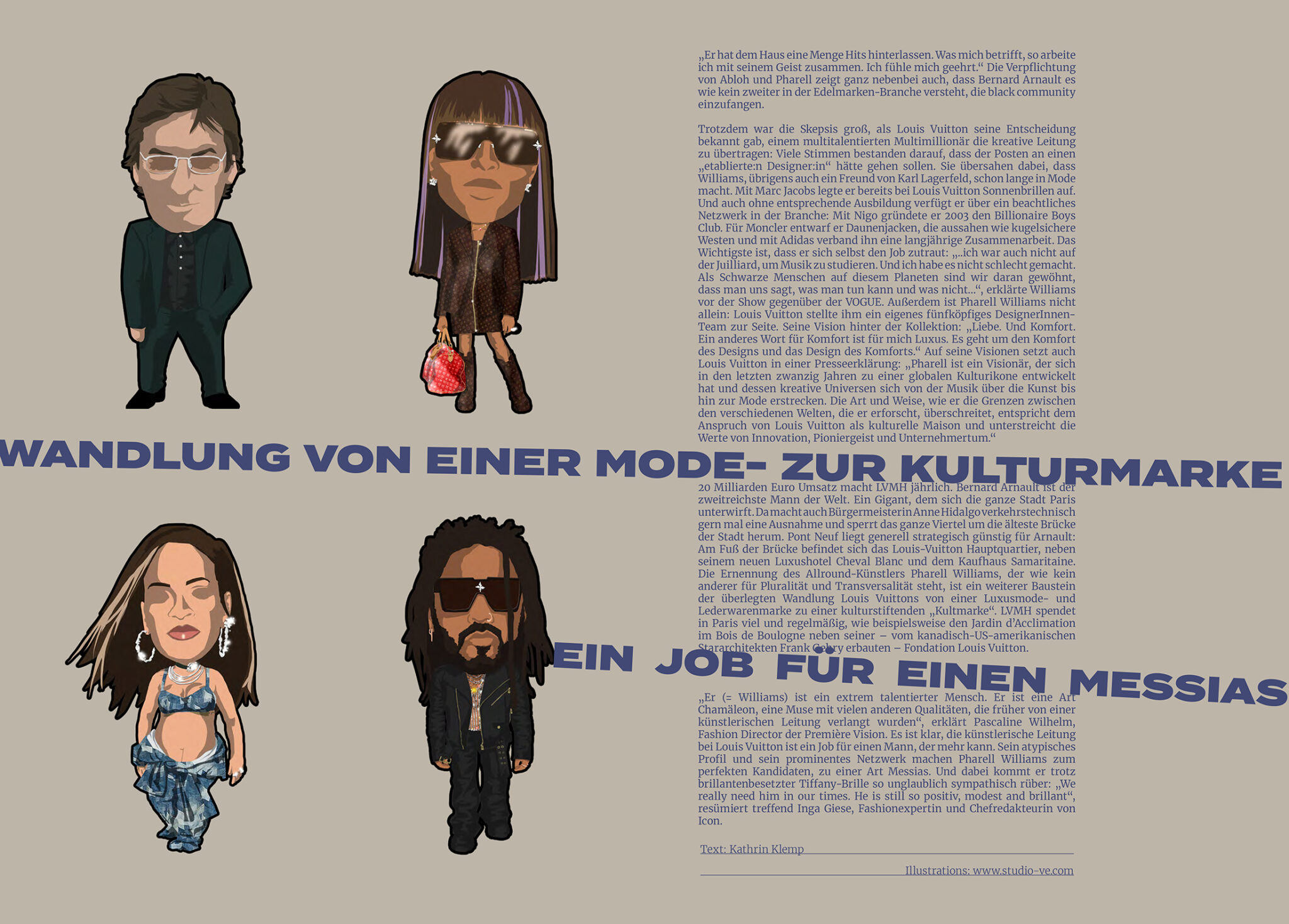
Subtitel: Zum Auftakt der Pariser Herrenmodewoche mit den Kollektionen Frühjahr/Sommer 2024 zelebriert Popstar Pharell Williams seine erste Männerkollektion fürs Luxuslabel Louis Vuitton. In der Front Row unterstützen ihn Celebrities wie Rihanna, Naomi Campbell, Beyoncé und Lenny Kravitz – alle in Louis-Vuitton-Looks. Alles ein großangelegter Marketing-Coup des Monsieur Arnault oder steckt mehr dahinter?

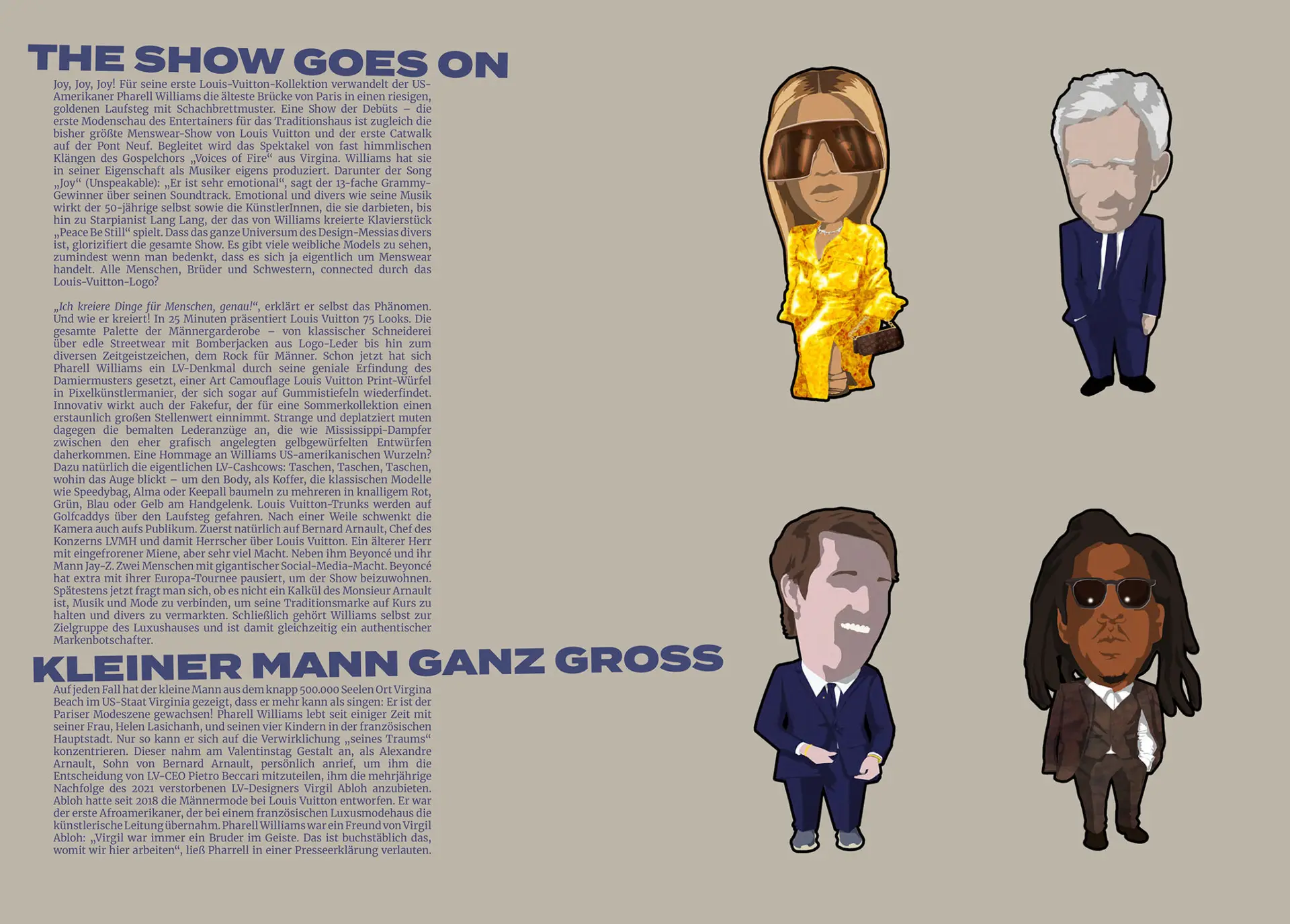
Joy, Joy, Joy! Für seine erste Louis-Vuitton-Kollektion verwandelt der US-Amerikaner Pharell Williams die älteste Brücke von Paris in einen riesigen, goldenen Laufsteg mit Schachbrettmuster. Eine Show der Debüts – die erste Modenschau des Entertainers für das Traditionshaus ist zugleich die bisher größte Menswear-Show von Louis Vuitton und der erste Catwalk auf der Pont Neuf. Begleitet wird das Spektakel von fast himmlischen Klängen des Gospelchors „Voices of Fire“ aus Virgina. Williams hat sie in seiner Eigenschaft als Musiker eigens produziert. Darunter der Song „Joy“ (Unspeakable): „Er ist sehr emotional“, sagt der 13-fache Grammy-Gewinner über seinen Soundtrack. Emotional und divers wie seine Musik wirkt der 50-jährige selbst sowie die KünstlerInnen, die sie darbieten, bis hin zu Starpianist Lang Lang, der das von Williams kreierte Klavierstück „Peace Be Still“ spielt. Dass das ganze Universum des Design-Messias divers ist, glorizifiert die gesamte Show. Es gibt viele weibliche Models zu sehen, zumindest wenn man bedenkt, dass es sich ja eigentlich um Menswear handelt. Alle Menschen Brüder und Schwestern, connected durch das Louis-Vuitton-Logo?
The Show goes on
„Ich kreiere Dinge für Menschen, genau!“, erklärt er selbst das Phänomen. Und wie er kreiert! In 25 Minuten präsentiert Louis Vuitton 75 Looks. Die gesamte Palette der Männergarderobe – von klassischer Schneiderei über edle Streetwear mit Bomberjacken aus Logo-Leder bis hin zum diversen Zeitgeistzeichen, dem Rock für Männer. Schon jetzt hat sich Pharell Williams ein LV-Denkmal durch seine geniale Erfindung des Damiermusters gesetzt, einer Art Camouflage Louis Vuitton Print-Würfel in Pixelkünstlermanier, der sich sogar auf Gummistiefeln wiederfindet. Innovativ wirkt auch der Fakefur, der für eine Sommer Kollektion einen erstaunlich großen Stellenwert einnimmt. Strange und deplatziert muten dagegen die bemalten Lederanzüge an, die wie Mississippi-Dampfer zwischen den eher grafisch angelegten gelbgewürfelten Entwürfen daherkommen. Eine Hommage an Williams US-amerikanischen Wurzeln? Dazu natürlich die eigentlichen LV-Cashcows: Taschen, Taschen, Taschen, wohin das Auge blickt – um den Body, als Koffer, die klassischen Modelle wie Speedybag, Alma oder Keepall baumeln zu mehreren in knalligem Rot, Grün, Blau oder Gelb am Handgelenk. Louis Vuitton-Trunks werden auf Golfcaddys über den Laufsteg gefahren. Nach einer Weile schwenkt die Kamera auch aufs Publikum. Zuerst natürlich auf Bernard Arnault, Chef des Konzerns LVMH und damit Herrscher über Louis Vuitton. Ein älterer Herr mit eingefrorener Miene, aber sehr viel Macht. Neben ihm Beyoncé und ihr Mann Jay-Z. Zwei Menschen mit gigantischer Social-Media-Macht. Beyonce hat extra mit ihrer Europa-Tournee pausiert, um der Show beizuwohnen. Spätestens jetzt fragt man sich, ob es nicht ein Kalkül des Monsieur Arnault ist, Musik und Mode zu verbinden, um seine Traditionsmarke auf Kurs zu halten und divers zu vermarkten. Schließlich gehört Williams selbst zur Zielgruppe des Luxushauses und ist damit gleichzeitig ein authentischer Markenbotschafter.

Kleiner Mann ganz groß
Auf jeden Fall hat der kleine Mann aus dem knapp 500.000 Seelen Ort Virgina Beach im US-Staat Virginia gezeigt, dass er mehr kann als singen: Er ist der Pariser Modeszene gewachsen! Pharell Williams lebt seit einiger Zeit mit seiner Frau, Helen Lasichanh, und seinen vier Kindern in der französischen Hauptstadt. Nur so kann er sich auf die Verwirklichung „seines Traums“ konzentrieren. Dieser nahm am Valentinstag Gestalt an, als Alexandre Arnault, Sohn von Bernard Arnault, persönlich anrief, um ihm die Entscheidung von LV-CEO Pietro Beccari mitzuteilen, ihm die mehrjährige Nachfolge des 2021 verstorbenen LV-Designers Virgil Abloh anzubieten. Abloh hatte seit 2018 die Männermode bei Louis Vuitton entworfen. Er war der erste Afroamerikaner, der bei einem französischen Luxusmodehaus die künstlerische Leitung übernahm. Pharell Williams war ein Freund von Virgil Abloh: „Virgil war immer ein Bruder im Geiste. Das ist buchstäblich das, womit wir hier arbeiten“, ließ Pharrell in einer Presseerklärung verlauten. „Er hat dem Haus eine Menge Hits hinterlassen. Was mich betrifft, so arbeite ich mit seinem Geist zusammen. Ich fühle mich geehrt.“ Die Verpflichtung von Abloh und Pharell zeigt ganz nebenbei auch, dass Bernard Arnault es wie kein zweiter in der Edelmarken-Branche versteht, die black community einzufangen.
Trotzdem war die Skepsis groß, als Louis Vuitton seine Entscheidung bekannt gab, einem multitalentierten Multimillionär die kreative Leitung zu übertragen: Viele Stimmen bestanden darauf, dass der Posten an einen „etablierte:n Designer:in“ hätte gehen sollen. Sie übersahen dabei, dass Williams, übrigens auch ein Freund von Karl Lagerfeld, schon lange in Mode macht. Mit Marc Jacobs legte er bereits bei Louis Vuitton Sonnenbrillen auf. Und auch ohne entsprechende Ausbildung verfügt er über ein beachtliches Netzwerk in der Branche: Mit Nigo gründete er 2003 den Billionaire Boys Club. Für Moncler entwarf er Daunenjacken, die aussahen wie kugelsichere Westen und mit Adidas verband ihn eine langjährige Zusammenarbeit. Das Wichtigste ist, dass er sich selbst den Job zutraut: „..ich war auch nicht auf der Juilliard, um Musik zu studieren. Und ich habe es nicht schlecht gemacht. Als Schwarze Menschen auf diesem Planeten sind wir daran gewöhnt, dass man uns sagt, was man tun kann und was nicht…“, erklärte Williams vor der Show gegenüber der VOGUE. Außerdem ist Pharell Williams nicht allein: Louis Vuitton stellte ihm ein eigenes fünfköpfiges DesignerInnen-Team zur Seite. Seine Vision hinter der Kollektion: „Liebe. Und Komfort. Ein anderes Wort für Komfort ist für mich Luxus. Es geht um den Komfort des Designs und das Design des Komforts.“ Auf seine Visionen setzt auch Louis Vuitton in einer Presseerklärung: „Pharell ist ein Visionär, der sich in den letzten zwanzig Jahren zu einer globalen Kulturikone entwickelt hat und dessen kreative Universen sich von der Musik über die Kunst bis hin zur Mode erstrecken. Die Art und Weise, wie er die Grenzen zwischen den verschiedenen Welten, die er erforscht, überschreitet, entspricht dem Anspruch von Louis Vuitton als kulturelle Maison und unterstreicht die Werte von Innovation, Pioniergeist und Unternehmertum.“
Wandlung von einer Mode- zur Kulturmarke
20 Milliarden Euro Umsatz macht LVMH jährlich. Bernard Arnault ist der zweitreichste Mann der Welt. Ein Gigant, dem sich die ganze Stadt Paris unterwirft. Da macht auch Bürgermeisterin Anne Hidalgo verkehrstechnisch gern mal eine Ausnahme und sperrt das ganze Viertel um die älteste Brücke der Stadt herum. Pont Neuf liegt generell strategisch günstig für Arnault: Am Fuß der Brücke befindet sich das Louis-Vuitton Hauptquartier, neben seinem neuen Luxushotel Cheval Blanc und dem Kaufhaus Samaritaine. Die Ernennung des Allround-Künstlers Pharell Williams, der wie kein anderer für Pluralität und Transversalität steht, ist ein weiterer Baustein der überlegten Wandlung Louis Vuittons von einer Luxusmode- und Lederwarenmarke zu einer kulturstiftenden „Kultmarke“. LVMH spendet in Paris viel und regelmäßig, wie beispielsweise den Jardin d’Acclimation im Bois de Boulogne neben seiner – vom kanadisch-US-amerikanischen Stararchitekten Frank Gehry erbauten – Fondation Louis Vuitton.
Ein Job für einen Messias
„Er (= Williams) ist ein extrem talentierter Mensch. Er ist eine Art Chamäleon, eine Muse mit vielen anderen Qualitäten, die früher von einer künstlerischen Leitung verlangt wurden“, erklärt Pascaline Wilhelm, Fashion Director der Première Vision. Es ist klar, die künstlerische Leitung bei Louis Vuitton ist ein Job für einen Mann, der mehr kann. Sein atypisches Profil und sein prominentes Netzwerk machen Pharell Williams zum perfekten Kandidaten, zu einer Art Messias. Und dabei kommt er trotz brillantenbesetzter Tiffany-Brille so unglaublich sympathisch rüber: „We really need him in our times. He is still so positiv, modest and brillant“, resümiert treffend Inga Giese, Fashionexpertin und Chefredakteurin von Icon.

Just Phriends – Pharell goes Fashion
Words: Kathrin Klemp
Illustrations: Studio VE

Kategorien
SOCIETY

Stencil Culture

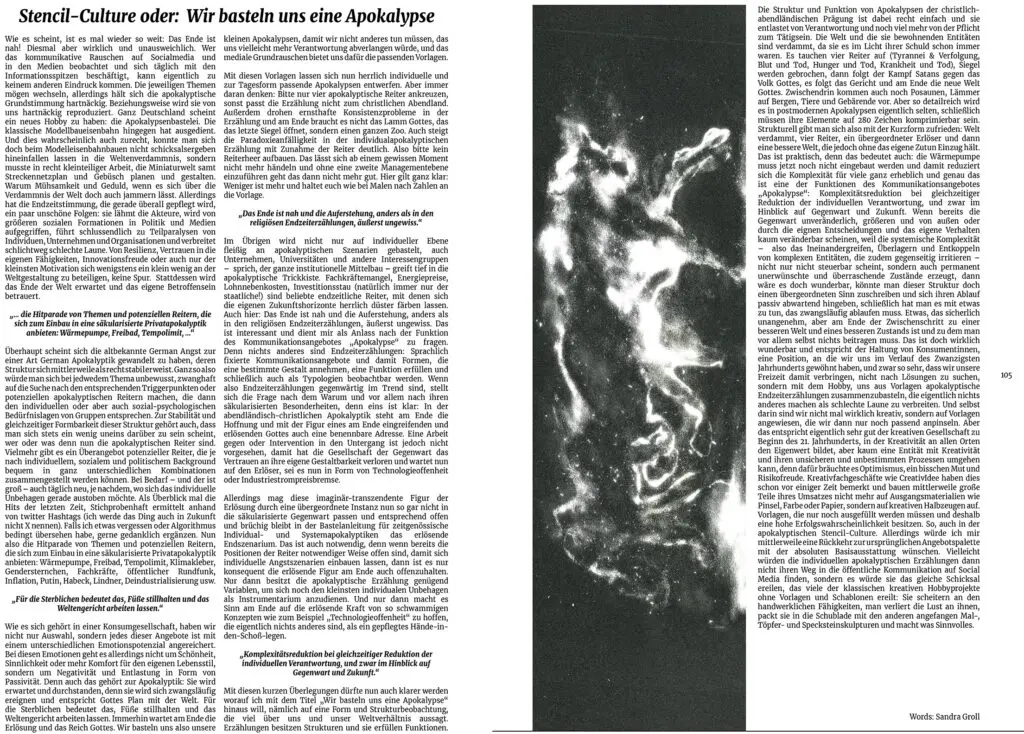
„Stencil Culture oder: Wir basteln uns eine Apokalypse“

Words: Sandra Groll

Kategorien
SOCIETY

Nothing new for a year

NOTHING NEW FOR A YEAR

Jane Gorley decided to buy no new clothes for a year.
An interview about renunciation.


Cyte:Tell us a little bit about you. What is your background, what is your profession?

Jane: I’m a brand and creative director, I started my career in print publishing and moved to digital commerce. I’ve been working in fashion and luxury for most of my career.

Cyte: Why did you decide to buy nothing new for a year?

Jane: For my birthday last year, I decided that I wanted to do something meaningful. Not to try to instigate anything, or influence anyone, but to try to learn something and test myself. Having been eco-conscious for most of my life, influenced by my mother mostly, in recent years I’ve been feeling extra guilty about my shopping habit. Although it probably is minor compared to some people, I realised that shopping, mainly vintage and sample sales mind you, was one of my favourite hobbies. I love the hunt, and the dopamine hit from finding something unique, extra special or for a really good price is so satisfying! But my wardrobe is full, and I really don’t need anything new. After moving from London to New York, then New York to Toronto, and finally back to London again over the past few years, I was very aware of all of my belongings and how much they were literally weighing me down. I felt like I should be able to manage without anything new (or new to me even) for a year, and I made it public via my Instagram account to hold myself accountable.

Cyte: What was the most difficult part for you?

Jane: So far the most difficult part is resisting that hunt. When I see a lovely vintage shop or even my local charity shops and I have to avoid the clothing rails. I’ve been satisfying the urge somewhat by looking at books or homewares instead. Also socks! Many of mine now have holes, so I’ve been stealing my husband or daughters instead of learning how to repair them. Learning how to darn socks is on my list of things to do.

Cyte: With your background in fashion, how do you look at the fashion world
now after a few month of buying nothing new? How is your general view
on the fashion world?

Jane: Like many people in the fashion industry, I’ve been feeling disillusioned by the cycle for awhile now. We are trained to worship newness, and the marketing cycle encourages this. We should be following Vivienne Westwood’s mantra to consume less, appreciating quality construction and materials that are meant to last a lifetime, and normalising repairs.

Cyte: You said shopping was a kind of hobby for you, what did you do instead?

Jane: I have to admit that shopping for furniture and homewares has taken the place for now, since we just moved into a new unfurnished home. I am actively trying to buy used and vintage. I also have taken up gardening!

Cyte: How did your friends and family respond to your decision?

Jane: My friends have reacted with curiosity, frequently asking how it’s going. Especially my fellow shopping addicts. But I think they are impressed and maybe even a little inspired, if not to stop completely but to shop less and consider more.

Cyte:How much money did you save in this year?

Jane: Good question. I would say a few thousand pounds for sure, however I’ve definitely spent that on furnishing my flat.

Cyte: Did sustainability, production circumstances, environmental issues etc. play
a role in your decision?

Jane: Absolutely – the entire fashion industry needs to slow down, and we have to get used to paying more. I don’t know if that will really happen, but it does seem like it has since the pandemic. I’ve seen the waste first hand, when the fashion season is over and everything is discounted. You see all of the unwanted goods in a jumble on the hangars, and then realise that they will be going to landfill.

Cyte: Did feel relieved or did you miss shopping?

Jane: I mostly feel relieved, and am appreciating the clothes that I already have a lot more. Occasionally I miss it, especially when I come across a sample sale for a brand that I especially love. I’m also getting better at getting rid of items that I never wear, either because they don’t fit or don’t suit me. 

I was hoping to learn something specific, like a revelation about clothing, fashion, adornment and my sense of self. But what has really happened is more like a sense of self control. I can stop myself from buying something on a whim, and hopefully I will continue to do so in the future.

Cyte: Can you describe your feelings during your first few month, when you were in town, passing by all those tempting shops?

Jane: One interesting reaction was while shopping with my daughter – she was looking to spend a gift card at a trendy high street chain and as I browsed waiting for her, I noticed that all of the clothes were vintage inspired. It highlighted how little real newness and creativity there is now in fashion, the brands are just copying things from the past and the younger generation perceives it as new. 

I am definitely tempted to browse, but it’s actually liberating going into shops knowing that you’re not going to buy anything. A kind of relief from the stress of the consumption cycle and the tyranny of too much choice.

Cyte: Did you meet other people, who changed their attitude towards fashion or consume in general?

Jane: Quite a few of the people I know from the fashion industry have changed their attitude towards fashion, working towards improving things and trying to make the industry more sustainable. For example a former colleague is working for a start-up that is connecting fashion retailers to textile recycling plants and creating a kind of loyalty program where customers get points to redeem old garments. Other friends have created fully up-cycled brands, where clothes are one-of-a-kind and made to order. More expensive but also unique and beyond trends. Also I know people who are investing in and exploring sustainable textiles, alternative to toxic and oil-based fabrics.

Cyte: How would you change the fashion system for better? What went wrong in your opinion?

Many changes need to occur – brands should be responsible for the full life-cycle of the products they sell, forced to take garments back for repair or recycling once they are too worn. Any non-recyclable textiles made with plastics or oil by-products should be heavily taxed with the revenue going towards environmental improvements. Burning or destroying unwanted stock should be illegal. Like everything with the consumerist culture, what went wrong is corporate greed and the demand for growth at any cost.

Cyte: Are there any brands who act reasonable or responsible today?

Jane: I love the slow brands working with vintage fabrics; By Walid, Coverlette, Rentrayage, E.L.V. Denim… most large brands are greenwashing like crazy, but I admire Ganni for it’s transparent expression of how they are trying to be continuously improve their environmental credentials without misleading anyone.

Cyte: Do you feel now less is more?

Jane: Absolutely, and I also appreciate what I have more, and will approach my purchases with a great deal more consideration and thought when I begin to shop again at my next birthday.


Kategorien
BEAUTY

a story about smells and hair

„a story about smells and hair“

Photograph: Stephan Ziehen
Styling: Jörg Struth
Hair: Jesus Rodriguez for Oribe
Make-Up: Lisa Neubacher@Bigoudi
Models: Laura Louis + Mats Botha@Kult Models
Sophie Braunfelds@Le Management

Kategorien
FASHION

New looks for a/w

Illustrations: Fritz Erler

Kategorien
RESTAURANTS

Santiago Lastra Koi

Santiago Lastra – the artisan turned artist!

Words: Junior Lodge
Photographs: Heiko Prigge


Six weeks have elapsed since dining at KOL and my thoughts on the experience remain disjointed and unclear. The cold facts of having lunch at the Michelin-star Mexican restaurant in London are easy to summon. I imbibed the fashionable restaurant’s eight-course tasting menu and devoured it with a divine mezcal-laced cocktail. Santiago Lastra – the restaurant’s chef, curates a cluster of dishes obviously aimed at pleasing the palate. But the charming food cognoscenti offers food that defies normal convention. The names of the dishes all bear homage to food deeply steeped in Mexican traditions – Jericalla (traditional Mexican custard); Rapsado (shaved ice); Tamal (steamed corn cake); Pipian; Oblea; and the generous servings of tortilla.
Those basic information on KOL’s tasting menu ignores a simple truth. Lastra’s artfully crafted food challenges traditional tastes and theatrically delivers the unexpected. For example, Jericalla is subverted with a panoply of custard, morita chili, pink fir potato and topped with caviar. Raspado couples scallops, sesame and almond mole, beach rose with shaved ice to deliver a deceptively cool look (pun intended). The crowd favourite oblea mixes Cornish crab with fermented gooseberries and topped with a notable hint of scotch bonnet. The pipian offers a rock sapphire in kombucha and mezcal broth. Even the tortillas – that most decorated Mexican culinary accessory – are decked in a host of inviting flavours – purple carrot, coloradito and fermented blackcurrent. Lunch ended with a reprise of Apple’s infamous “one more thing” in the form of a cocoa butter paste based dessert laced with a shot of chili reduction.
After the meal, Lastra politely ushered me into one of the calmer rooms in the basement on London-based KOL restaurant. We are due to discuss Michelin-starred chef’s culinary journey and creative approach. But before commencing the chat, I wanted to overcome a bout of discombobulation and regain my composure. I needed to stymie the sensory jolt caused by consuming Lastra’s layered, complex and yet ultimately beautifully crafted food. Part of my challenge was understanding what had transpired – was my stomach pleasurably assailed by KOL’s sumptuous food or were my senses seduced, nay suspended?
The conversation with Lastra should instil intellectual clarity and aid my recovery from a case of gastronomic intemperance. It is easy to talk with the telegenic, tall and lean Mexican chef as he oozes full command of culinary techniques – far beyond the reach of his Mexican homeland. This is unsurprising as Lastra has worked with a clutch of high-powered, high-class establishments including managing NOMA’s pop up restaurant in Mexico. But there is also something professorial about the KOL chef reflective of his advanced theoretical studies and research, most notably at the Basque Culinary Centre, University of Copenhagen and Nordic Food Lab. At the later outpost, Lastra researched nixtamalization – the technique of cooking corn with calcium using Nordic grains. What a triumph for a kid that wanted to be a mathematician and participated at the Maths Olympic!
The Mexican has an interesting journey into becoming an elite chef. Lastra states that his food relationship to cooking galvanised by purchasing a box of Ritz crackers that came adorned with a crab dip recipe as a 15 year-old. “I was amazed that everyone enjoyed the dish and found this joy powerful. I always make sure that the crab dip was in the fridge along with the crackers. Then I just really enjoyed making something and seeing others relish it was just as fulfilling. That first day being in the kitchen preparing the crab recipe remains life-changing!”
Lastra continues “I have no idea of how I end up doing this because I don’t have a perfect chef environment. My parents did now own a farm or a restaurant and cooking was not done in a real manner at home. But then I remember loving to eat and becoming curious about food. In a one-month stretch, Lastra lost his father, grandfather, and grandmother. In seeking to cope with this intense loss, the Michelin star chef began cooking at home and instantly registered the joy brought to his beloved mother and brother. Lastra instantly saw the emotive power of food and sensed the desire to spread culinary joy to the world.
In this pursuit the young Santiago committed to learning from the best and becoming the finest at his craft. Like most other top chefs, Lastra started his professional journey working in kitchen as a chef de partie without giving any thought to creating his own recipes. But after ten years of being the artisan in the kitchen, Lastra realised a seminal moment had arrived when ideas started to flood his fertile brain. Travelling fed Lastra’s ideas by cementing his realisation that connecting food with people coupled with the insight that personalities and culture of the people get reflected into flavours. “It is interesting to see that in different parts of the world and see different patterns. Then suddenly working with great chefs helps you as well to have your own view of quality.”
The best lesson learnt from his main mentor – Rene Redzepi was the ability to identify good food. Working with the Danish chef on NOMA Mexico allowed Lastra to first crystalise his own culinary identity but also deepen a desire to create memories for people. Unsurprisingly, the initial dream was to launch a research and development centre in Mexico to test plants and techniques, develop new ingredients and relay knowledge to interested communities.
The restaurant takes its name from the Judeo-Spanish word for cabbage – a nod to Lastra’s goal of elevating high quality yet mundane ingredients. KOL’s tagline is “our memories of Mexico, re-imagined with British produce.” I prodded Lastra about whether the thrust on local ingredients was an attempt to avert supply concerns or rather to project a manifesto? His response was as delectable as the tasting menu he oversees at KOL. “London was chosen as a location due to the cosmopolis’ vastly different weather relative to Mexico. In wanting to develop something truly unique, this also extends to the ingredients. Besides the contrast with traditional British ingredients makes the dining experience that more powerful. Our approach is based on adaptation by using Mexican inspiration like a memory target in terms of flavours and a guideline, but the canvas and the paint remains quintessentially British.”
KOL’s arresting cuisine combines a strict food-making method with an unguarded attempt to seduce. “The direction is certainly to seduce people, to give people a journey of heat and a journey of presenting the season and concepts, and the value of food. But in a way that is really just delicious and straightforward for them to just enjoy it, even if you have no idea what is going on, you still like it. With sequencing assuming such importance in a tasting menu, customer feedback has allowed the restaurant team to sharpen its focus and techniques. The mellowing of KOL’s approach is a process fully aided by R&D team with its own dedicated kitchen.” Another sign of the power of details is the existence of KOL’s own tortilla factory that churns each day out hundreds of the Mexican staple.
Lastra proudly explains the important role played by his colleagues – the sommelier, our general manager, head chef and bartenders. “Everyone samples the dishes and comment to feed the emergence of improved dishes, better recipes, and ultimately, vastly improved alignment of the fully creative process. Having a team like this allows us to forge collective growth and advance the original idea of building a community.”
The enterprising chef savours KOL’s award of a prized Michelin star and I quizzed him about this grand form of professional affirmation. Lastra’s response was both swift and unambiguous – “we opened and then immediately came the pandemic with its grave commercial impact. The Michelin star represents a form of validation for the restaurant staff and the consistent quality of our offering. But the award also allows me to reassure them of the merits of our own culinary path.”
Our conversation ends on Lastra’s interpretation of fine dining where his restaurant lacks tables decked out in stiffened white lines on table. “We view fine dining as a performance or an exhibition around the guests‘ personal experience. We seek to create a special experience and thereby establish a memory. The great thing about the restaurant is that this memory can be shared with others. At the moment that you are sharing this special memory at KOL, my staff is working hard to make sure you have the best time. The people, the service, the connection with the people that is serving you, and the way that they understand things that they can learn things about you to make you feel even happier. We seek to share our passion for food through hospitality and thereby establish a connection with the people that you love. That is what the service is with, that is what we try to do with service as well. KOL offers an exhibition, a sharing of flavours, and a performance with human connection where you can have an experience of memory.”
After much reflection, I have finally formed a coherent view on the KOL dining experience. The tasting menu blends food that finely knits innovation with tradition. There is also a mix of ingredients that seemingly are at odds with each other yet ultimately harmonise to release spasms of culinary joy. KOL deliberately avoids typical Mexican ingredients – avocado and limes are nowhere to be seen on the menu! Such a deliberate choice allows Lastra to develop a menu that not only enhances sustainability but showcases the finest British ingredients. The dining experience is further enhanced by the near theatrical twists – shots of Scotch pepper with cocoa paste or a custard that is not billed as a dessert! The exquisite food would remain a cold offer without the warm generosity of KOL’s personnel. Of course, this starts with the dashing Lastra whose relaxed demeanour oozes calm. But each staff member approached the table with warmth, nuggets of information looks and left with a hint of their own personality. No wonder I left the restaurant giddy with consummate pleasure.

Kategorien
ART

Bas Kosters

JOY – Bas Kosters

Subtitle: How amazing it must be if you take a ferry to work as your public transport, as Bas does every morning when he cycles to his atelier in the NDSM district of Amsterdam. An old wharf turned into lots of artists workshops and ateliers, is the place where he creates all his wonderful and joyful creatures, costumes, ceramics, drawings and masks.

Cyte: How did it all start?

Bas: Mmmmmh…

C: Did you study?

Bas: Yes, I studied! For a long time – 8 years! I studied at a fashion school – 3 different levels. But already as a child I I was a playful child, played with dolls, loved dressing up, loved shinny things, loved my mums make-up, loved to make little shows in the backyard playing Kermit the frog in my green pyjamas with a green painted face. So, sometimes I realize that I still do things which I loved as a child, but now as a profession. Which is actually quite funny but also a bit disturbing You would hope that you would progress as a person – which I probably did, but it’s a funny thought!

Cyte: How would you describe you work? Is it art, is it costume design…what is it?

Bas: Nowadays we mainly focus on an art practice. I stopped making fashion collections a few years ago and I am working now on a series of artworks and research projects about topics like “JOY” that’s my most recent research project and…

C: Is that a task you give yourself or is there someone from the outside who approaches you?

Bas: No, it is a task I give myself. So, I am working on several projects mostly at the same time, but “JOY” now is the largest project I am working on. It involves digital art, textile art, costumes, photography, installation art, ceramics – very many different things. Painting, tapestry…

C: So, you develop that and then you with your team come up with the various things?
Or how does it work?

Bas: No, I’m always in charge of what happens, so I give the creative direction and then the team follows my sketches, so I sketch and the team executes.

C: And then the result, the painting, photograph or whatever comes out, you exhibit this and then people are going to buy it, or how does it work?

Bas: I have worked the last couple of years with several different galleries, I’m also part of group exhibitions, I also present my work through individual presentations that we host ourselves – like small exhibitions. And I also participate in art fairs and design fairs, so there are many different ways to present my work to the outside world.

C: Do you find that has changed? Is it more difficult now? I am asking that because of your work which I have seen so far, it’s quite interdisciplinary, it has humour, it is very colourful, itis a lot and it is very hard to categorize. And I know that the art-world like to label things and wants to understand what is he actually doing?

Bas: (laughs)…I like to understand also!

No, I know very well what we are doing! For me, I just want to do things that are important and bring across my stories about “care” “engagement“ “good intentions” these are things which are very important to me. But even when I was running a more fashion orientated studio, it was also going in so many different directions. I was a party host, I did performance – dance performance, I had a Rock’n’Roll band. So, my work has always been very interdisciplinary and also very much about the fact, that you can be your own creation and your own creator. So, I create my space, I create my boundaries, or I try to take them away by just moving very freely and also by taking in all the techniques or disciplines that I want use to bring across my stories.

For example, when I graduated, I created a fictive image of a Rock’n’Roll band and then I thought, maybe I should make the music too, so I wrote the songs and I found a producer and we recorded the songs and performed them, so I don’t limit myself, it is almost like a Pippi Longstocking-syndrome, she says: “I don’t know how to do it, but I think I can do it”. It’s really a kind of “WHY NOT“-state of mind. This has pros and cons. Yes, people have problems pinpointing me, but they know to pinpoint me as the person, who is difficult to pinpoint. So, it’s a double standard, which has its advantages and also its disadvantages.

C: Some of your work reminds me of Jonathan Meese, this artist from Germany. Where you take the “kindergarten” to the art world, he takes the art world to the “kindergarten.” Similar approaches, but from the opposite end.

Bas: I think in an imaginary world, a world of innocence and playfulness appeals to a lot of creatives and artists in general. And I also think that this is a very valuable visual language because we know it so well. And it is also so charged with certain thoughts and ideas – it is also so interesting to do something with it, because the effect is so clear. Because of its innocence, because of its global meaning. If you run into a kindergarten in Africa, you will recognize it, because of the playful approach, how it is decorated and how they layout the interior, so, I think that’s also very interesting. There are very many artists, that linger to the innocence of the child world. It is also a very big part of popular culture, which also makes it very interesting.

C: Why did you stop doing fashion?

Bas: I did not really totally stop making fashion, we still do some small production and I still work as costume designer, but I like to consider my practice to be fluid and actually when I graduated the first one and a half years, after my graduation I was very active, but I did not really make collections. So, the beginning of my career was very experimental and actually appreciated that creativity could float so much, that in 2015, after of making a couple of semi-commercial collections, I decided that I really wanted to embody that creativity that was so boundless from the beginning of my career. So, I decided, that this should be really my main focus. And in a sense that also let me to the practice, that I’m doing now, which is so much more about creating what I want and making things I hope that will be cherished and nurtured. These things are not garments any more, but artworks. But that’s not the reasons, I don’t make art to make art. I want to express myself and this is now the path, that I have chosen. So, it’s not so harsh actually, like “I don’t want to do fashion anymore “. But I do think the fashion industry has something really negative about it.

For me, fashion was always about individuality, an individual beauty and a performance of yourself and I think nowadays, even more than when I graduated, especially in global, open society with internet, mobile phones, I think it is very difficult to be authentic. We are in a capitalistic overdrive, where fashion just stirs up an enormous wave of consumerism, which goes past any sensible judgement of people who consume it. We kind of know now that it is better to buy biological meat than the cheap pumped up one. But why we still do it with fashion? It is just very unclear. I think this world is just way late with taking precautions that fast fashion should be taxed really highly, because it is bad for our health, like smoking, drinking and drugs and all these other things. I think it is the fault of our governments, who don’t make regulations, to keep us away from consuming this cheap fashion. It’s just so bad for our environment.

C: Looking at your fashion work, I think you opened a door to many others, like Matty Bowan, Charles Jefferey and also Jeremy Scott, who were there before, but who are on the same wavelength as you. All are very playful, colourful and completely non-commercial. They all come from the same place, where you came from.

Bas: I think we definitely have the same perspective on fashion. In a sense we all love fashion and we all love the craft of being a fashion designer. It is just a beautiful profession. But it also has become very hollow. Especially because the big companies, like LVHM and Kering etc., are growing and growing. They are like a darkness who take all the space. It is very good that there are still people who dream to create beautiful things, to propose different perspectives to this world and I applaud that. But it is just difficult to stand your ground and to really take that space, that we deserve. There is a small public for these things…my clothes were also expensive and I think the clothing of independent design labels will also be expensive, because it has a value and there is not a great public for it – of course there is a public, but they have so much choice.

C: There is a German designer in Paris, his name is Lutz Huelle and he is getting more and more successful, because he is doing the right things at the right time by doing lot of upcycling and slowly developing everything. But he says that there might be a point, when he still continues to grow, that he needs to become part of a big fashion company like LVMH. And my fear would be, that he would dilute his identity as many other brands.

Bas: It’s a strange world. I mean, for me…I have only one life. I want to do what is important for me. It’s not that I gave up on fashion, as I still like it, I still love it. I have a lot of enjoyment making costumes and dressing myself or doing some odd things here in the studio. I still love that.

C: When you do costumes, you do them for customers or…

Bas: I create for theatres and recently for a ballet, but we also do costumes just for performances. It’s all relatively small scale.

C: Who are important influences for you?

Bas: I have many idols. It’s also very clear, that I love designers like Zandra Rhodes, I think she is just fantastic. I love Vivienne Westwood, I love the early Gaultier, who was one of my teenage idols. I love anything spectacular and out of the ordinary and kind of making a little bit of friction. I love the designers, that show their engagement but also have an extraordinary fantasy. Artists like Jeff Koons, he is one of my big idols. Paul McCarthy is another one, a visual artist, who makes very gruesome, very dirty performances. So, I love the lascivious, I love the fantasy, I love the queerness, there are so many things which are inspirational for me. I love the world of commerce and advertisement, that’s why I love Jeff Koons for example because he is so commercial – I think that’s just fantastic.

C: Is there a mentor for you. Someone who looks after you?

Bas: When I was in art school, I was introduced to the head of a Dutch fashion master, called Angelique Westerhof, she has been a long time my mentor, but now she decided, that she doesn’t want to be my mentor anymore (laughs). She just wants to be my friend, which I understand. Sometimes you need to move on. Now I’m more a mentor of myself, also to my old interns, if they want advice, than I’m always open for discussion and conversation, when people don’t know where to go or what to do. But Angelique was someone who totally believed in me and really put me on the map, which was fantastic.

C: Do you think that you are very brave for what you stand for and what you represent?

Bas: It takes bravery, but on the other hand I could not NOT do it! So, it’s more of a necessity. I’ve always surrounded myself with courageous people, who fight for their own space, people of the LGBTQIA+ community. I think I was an activist, maybe before it became such a thing recently. On the other hand, I always been mega engaged – I don’t want to pat myself on the back for doing what I do, because I could not have done it in a different way. I just needed to do it.

C: Is therefore Amsterdam as place important for you? Could it have been somewhere else?

Bas: I moved here after art school and knew it was the place to be but never considered that I could have gone anywhere else. In that sense, yes, it could have been anywhere else but it was not a logical thought. And to be honest, I have travelled the world for work and have seen many different fantastic places but only in 2019, I secured a scholarship that allowed me to spend 2,5 months in Tokyo and 3 months in Los Angeles in an attempt to strengthen my artistic language and techniques. I also had a special residency at the TOM of Finland Foundation for erotic art where I learnt a lot. Perhaps this is the start of a new era with the prospect of another residency in porcelain making in Japan. So, I am definitely opening my whole practice, also to develop my own artistic voice. And to be honest, I am much more open now to learn things compared to my younger days, which I also find interesting because I am now more humble than before.

I can also be very strong-headed, very convinced of my own opinion and now I am becoming a bit more open. So, maybe I could work and live somewhere else, although I really love Amsterdam, I love the place, in particular, its homely nature. But the place where I live, doesn’t define my work- I define it! Things might be far easier in another place. But being Dutch and living in Amsterdam means that I have a rich life replete with lots of possibilities. It is also very clear that Amsterdam is not too big with my workshop being a fantastic place. yet it is inescapable to also note that Amsterdam is similar to every other European city in that it is vastly gentrified. Last week I was in Barcelona for a short escape and found a very hip coffee bar – the type that is now everywhere. People all want the same stuff in different places but it could actually be so much more fun to go somewhere and experience something typical for the place.

C: How did you get into ceramics, because I find it quite special and a little bit odd?

Bas: For me it is totally not odd. I’ve been making glass artwork since 2015 and I think my message and my language is just like a big storybook. How it manifest itself is just growing and growing in many different directions and the thing which I realized in making glass art is that there is really a different perception of value, when it comes to different artworks or outcomes of materials. Glass is a quite convincing medium to tell people of its importance and value. And my favourite media – textiles and paper are considered to be less valuable but are my safe space. So, in those materials I function the best but I my curiosity in ceramics grew.

if I could play around with the perception of value by making something heavy, to really bring weight to the table. But to be honest, I realized during my residencies that ceramics takes a lot of work, takes a lot of time and doesn’t t necessarily translate into value. Of course, it also has to do with one’s place in the market and how one positions the work. On the other hand, when I started doing the ceramics, there emerged different questions about my craftsmanship, creative process, stance towards the materials, towards my surroundings. So, this reflection was most helpful in that I realised that question about value became a bit less important. I was just really in the moment, creating the work, just finding new kind of storylines along the way, lead to new ideas of my practice also. And also, the opportunity to do it was just fantastic to do the residencies!

C: Thanks for the interview. Could we have a look your work now?

Kategorien
Books

T.C. Boyles

T.C. Boyle

Blue Skies

Übersetzt aus dem Englischen von Dirk van Gunsteren

Roman – Cli-Fi

Hanser Literaturverlage, Gebundene Ausgabe, 2023, 400 Seiten

Die Originalausgabe erschien 2023 unter dem Titel Blue Skies bei Liveright Publishing Corporation, W. W. Norton & Company, New York


Wäre ich eine „gestandene Feministin“ würde ich den Roman boykottieren. Gegebenenfalls den Autor – aber ich lese zum ersten Mal T.C. Boyle, daher erlaube ich mir keinen Rundumschlag und schiebe meinen aufwallenden, nicht beständigen Unwillen beiseite.

Zur Erläuterung dieses Intros: die zwei Frauen, die neben den drei Männern, die Hauptprotagonistinnen sind, werden als naiv, einfältig, frei von jeglichem beruflichen Ehrgeiz und finanziell abhängig von ihren Ehemännern gezeichnet. Man kann das alles ironisch oder auch zynisch betrachten – je nach Stimmung in meinem Fall. Ein Fakt, der mich gnädig stimmt und es humorig macht: die Männer kommen auch nicht so richtig smart rüber. Jeder wie er kann, go with the flow … mich würde eine männliche und brennend eine non-binäre Betrachtung interessieren > bitte an: mail@cytemagazin.de – aber bitte nur, wenn es wirklich von vorne bis hinten durchgelesen wurde.


„Kalifornien brennt und Florida geht unter“


Irgendwann, in nicht allzu ferner Zukunft: Kalifornien verdorrt und verbrennt, Florida lebt im ewigen Hurrikan und versinkt dazu noch im Meer. Florida trifft es augenscheinlich härter, denn es kommen Dauerregen und eine waschküchenartige Luftfeuchtigkeit hinzu, die wiederrum Fäule provoziert, die einen beißenden Gestank, egal ob drinnen oder draußen, zur Folge hat und – zusammen mit den Termiten – die die edlen Holzhäuser zum Einsturz bringt. Versicherungen zahlen schon lange nicht mehr. Was für Aussichten. Da hilft es auch nicht, wenn wir jetzt anfangen CO2 zu sparen … Gerade gestern, 2.8.2023, war Earth Overshoot Day, Erdüberlastungstag. Deutschland hatte seine Ressourcen in diesem Jahr schon am 4. Mai 2023 aufgebraucht, USA am 14. März 2023, China immerhin erst am 2. Juni 2023 – Jamaika gewinnt mit 20. Dezember 2023. Aber ich vermische die Dinge und komme ab vom Buch.

Also Kalifornien brennt und Florida geht unter. Cat kauft sich eine Schlange, einen Tigerpython, während ihr Verlobter Todd seinen Tesla auf Hochglanz polieren lässt – trotz oder gerade wegen des ständigen Regens und der Flut. Keine Sorge, er hat selbstverständlich eine Rampe, auf die der Tesla jeden Abend gefahren wird, damit das Salzwasser, bei Flut, die Karosserie nicht angreift.

Also während Todd sich um sein Auto kümmert, kauft Cat sich einen kleinen Tigerpython. Er wird erst später auf fünf bis sechs Meter heranwachsen – und Unglück über Cat und Todd bringen. Cat kauft ihn sich ein bisschen aus Langeweile und ein bisschen – nein, rein aus Langeweile. Todd will (noch?) keine Kinder und Cat will Influencerin sein. Mit einer Schlange geht das sogar noch besser als mit Kindern. Eine Schlange kann man sich um den Hals legen und sie verleiht der Influencerin einen mystisch-animalischen Flair. Todd ist Barcadi-Botschafter, ist sehr viel unterwegs, auf Partys, meist umschwärmt von Frauen, denen er erklärt, welcher Rum womit am besten schmeckt. Cat trinkt am liebsten Mojitos, den ersten meist mittags. Neuerdings mit Willie, dem Python, wahlweise im Dekolleté schlängelnd oder im Schoß liegend. Selfies knipsend selbstverständlich. Alles für die treuen Follower. Es handelt sich um Willie I.


„Sie rettet jedes Insekt vor dem Ertrinken in ihrem Pool“


Cats Bruder Cooper lebt in der Nähe der Eltern in Kalifornien. Also der Landesteil, der vertrocknet und verbrennt. Cooper ist der Bugboy, der Käferjunge. Seit Kleinkindtagen folgt er allem, was kreucht, fleucht und fliegt. Insekten und damit deren Lebensraum sind seine Berufung. Er ist Entomologe. Er ist der Mahner, der Aktivist. Was Cat an Leichtigkeit und Gelassenheit versprüht, trägt Cooper als schwere Last und inneren Groll mit sich durch die Welt. Das potenziert sich, als er den rechten Unterarm durch einen Zeckenbiss verliert. Ausgerechnet eine Zecke. Eins der Lebewesen, deren Entwicklung und Einfluss auf die Welt er erforscht – bzw. seine Freundin (dies nur als Anmerkung fürs Protokoll. Lies selbst).

Ottilie ist die Mutter von Cat und Cooper. Sie lebt die klimatische Veränderung, folgt Coopers Mahnungen, seinem „Der Planet stirbt, seht Ihr das nicht?“ und versucht sich so klimaneutral und -bewusst wie irgend möglich zu verhalten. Sie rettet jedes Insekt vor dem Ertrinken in ihrem Pool. Sie pflanzt Wolfsmilchgewächse an, da diese besonders wichtig für den Erhalt der Monarchfalter sind, widmet sich dem Bienenvolk, dass Cooper ihr mitbringt und legt sich eine Grillenfarm zu, Eiweiszufuhr, Fleischersatz. Zwar sterben die Grillen ihr regelmäßig weg und auch die Bienen überleben es nicht. Aber das liegt nicht an mangelnder Pflege, ein weltweites Insektensterben greift um sich. Plötzlich ist die Welt still. Nur der Wind oder – je nach Standort – der Regen rauscht.


…“auf einem anderen Planeten, einem gesunden, von Menschen unberührten Planeten“


Neben dem nahenden Weltuntergang gibt es dann noch die menschlichen Dramen. Schlangen brechen aus Terrarien aus, Babys sterben – hier hat Willie II seinen unheilvollen Auftritt –, Paare trennen sich – Cats und Todds ohnehin fragwürdige Ehe zerbricht schließlich am Tod ihrer Zwillingstochter Sierra und den daraus folgenden Ereignissen –, Freundschaften werden auf die Probe gestellt – aufgrund eines verheerenden Feuers, das ganze Städte auslöscht müssen die Menschen näher zusammenrücken. Ottilie nimmt ihre beste Freundin Sylvie und deren Mann Peter bei sich auf, was sie immer öfter in das Naturschutzgebiet, das Cooper beaufsichtigt, flüchten lässt. Denn wenn beste Freunde zu Mitbewohnern werden, tun sich Abgründe auf.

Coopers Naturschutzgebiet besteht fast nur noch aus verdorrten Büschen, abgestorbenen Bäumen, staubigem Geröll. Ottilie und Cooper wandern stundenlang durch gleißendes Sonnenlicht. Ziel der Wanderung ist ein Kiefernwäldchen. Nach Gluthitze und nahender Ohnmacht lässt Boyle hier plötzlich die Natur aufleben, er lässt die Schmetterlinge fliegen, wie in einem Zauberwald, in einer Oase, wie in einer anderen Welt, auf einem anderen Planeten, einem gesunden, von Menschen unberührten Planeten. Ein schöner Moment, der Ottilie vielleicht Hoffnung gibt, dass ihre einzige Enkelin nicht nur Schreckliches, Unheilvolles in ihrer Zukunft zu erwarten hat.


Boyle bietet mit diesem Roman richtig gute Unterhaltung. Ganz nebenbei rüttelt er auf. Mich spricht er an. Ich werde nicht zur Aktivistin, aber ich werde noch stärker darauf achten, was ich tue und was ich anders tun kann, um daran beteiligt zu sein, den Planeten nicht noch mehr zu verletzen.

Und ich werde noch mehr Boyle lesen, um herauszufinden, ob er ein Frauenverachter ist oder grundsätzlich einfach Charaktere bloßstellt.

Lesen!


Kategorien
PEOPLE

Franz Liebig

Jedes Projekt, egal wie groß oder klein, lang oder kurz, hinterlässt Spuren.

Artist: Franz Liebig

Text: Claudia Ippen

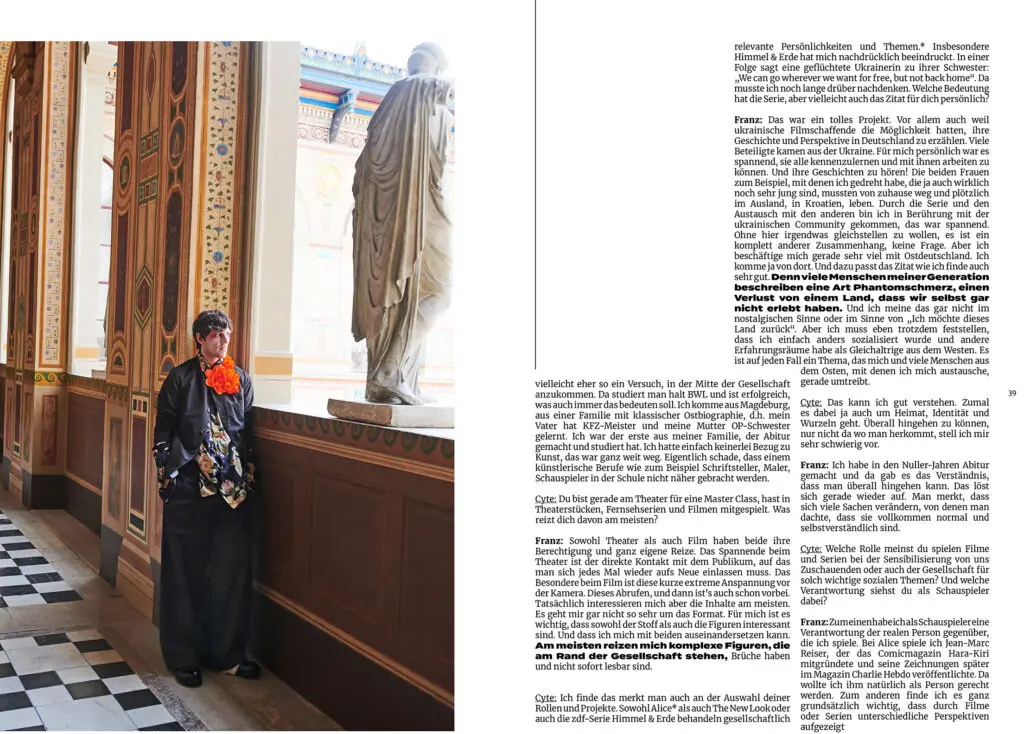
An einem sonnigen Junimorgen sitzen Franz und ich uns gegenüber. Leider nicht live, er ist in Paris und ich in Hamburg, dafür digital und bei einem zweiten Kaffee. Wir kommen sofort ins Erzählen – darüber, wie er über Umwege zur Schauspielerei gekommen ist, was ihn daran am meisten reizt und welche Themen ihm besonders am Herzen liegen. Inhalte sind ihm wichtig, das merkt man. Und komplexe Figuren, die man nicht sofort durchdringt. Franz macht, was sich für ihn richtig anfühlt, lässt sich immer wieder durch Begegnungen mit anderen Menschen und Künstlern inspirieren und, wie er sagt, an andere Orte bringen. Ich freu mich schon drauf, wo wir ihn als nächstes sehen, vielleicht wird’s ja auch ein eigenes Projekt über den Osten oder seine Großmütter. Ich bin gespannt!

Cyte: Du hattest mir ja schon geschrieben, dass du gerade nicht in Berlin bist. Sondern in Paris am

Theater. Vielleicht steigen wir da auch direkt ein, wo sitzt du gerade und warum?

Franz: Ich bin immer mal wieder in Paris. Ich habe hier studiert, und meine Agenturen befinden sich in Paris und Berlin. Dreiviertel des Jahres bin ich in Berlin und die restliche Zeit in Paris für Castings oder Drehs. Oder wie jetzt am Théâtre de la Tempête für eine dreiwöchige Master Class, eine Art Weiterbildung für Schauspieler mit Berufserfahrung. Das Théâtre de la Tempête ist toll. Es war das erste Theater in Paris, in dem ich ein Stück gesehen habe. Und jetzt habe ich die großartige Möglichkeit, mit dem Intendanten, Clément Poirée, zusammen zu arbeiten.

„Wir lernen, einen eigenen Text unter das Stück zu legen, nur dass es eben Bilder sind.“

Cyte: Woran arbeitet ihr gerade?

Franz: Im Prinzip ist es eine Art Labor, in dem wir an verschiedenen Schauspieltechniken arbeiten. Wir setzen uns gerade viel mit Visualisierung auseinander. Das heißt, wir visualisieren gemeinsam starke Bilder, um diese dann im Spiel umzusetzen. Zuschauer merken sehr schnell, wenn eine Schauspielerin oder ein Schauspieler kein konkretes Bild vor Augen hat. Das wird dann oft langweilig. Mit einem klaren Bild, von dem was man erzählen möchte, wird der Stoff sofort lebhaft für das Publikum.

Cyte: Das musst du mir genauer erklären. Geht es darum, Emotionalität und Glaubhaftigkeit

rüberzubringen? Das stell ich mir nämlich sehr schwierig vor, insbesondere wenn man eine Szene zum ersten Mal oder auch zum wiederholten Male spielt.

Franz: In der Schauspielausbildung lernt man Techniken, um Emotionalität abrufen zu können, ohne

immer selbst wie beim Method Acting die gesamte Intensität der Gefühle zu spüren. Die

Visualisierungen wiederum helfen dabei, die Erzählungen lebhaft zu halten. Auch durch neue Bilder,

die man sich immer wieder sucht. Es geht um fantasievolle Bilder, die den Text anregen. Es ist eine Art Strategie, ähnlich wie zum Beispiel das Arbeiten mit Subtexten. Wir lernen, einen eigenen Text unter das Stück zu legen, nur dass es eben Bilder sind. Ob ich jetzt zu sehr abdrifte?! (lacht)

„Es waren immer auch Begegnungen mit Menschen, die mich zur Schauspielerei und an andere Orte gebracht haben.“

Cyte: Stichwort Schauspielausbildung. Du hast Deine in Paris absolviert. Wie kam es

dazu?

Franz: Ich habe erst BWL studiert, teils in Deutschland teils in China, in London meinen MBA gemacht und fünf Jahre im Bereich Finance gearbeitet. Ich habe irgendwann gemerkt, dass Finance zwar ein

spannendes Feld ist, mich aber nicht wirklich bewegt. Ich konnte mir nicht vorstellen, meinen

Lebensabend damit zu verbringen. Als Teil des MBAs konnte ich einen Schauspielkurs belegen,

geleitet von John Lightbody, einem Schauspieler der u.a. am National Theatre gespielt hat. Da habe ich dann gemerkt, dass ich einen Zugang zur Schauspielerei habe. Und dass Schauspiel tatsächlich ein eigener Beruf ist, den man lernen kann. Das war mir vorher gar nicht so klar! Aus meinem Abiturjahrgang haben alle recht klassische Berufe gewählt, im Schauspielkurs in London kam ich das erste Mal in Kontakt mit anderen Schauspielern, mit Theater und Film. Und jetzt muss ich ein bisschen ausholen … Während meines Studiums in China, habe ich eine ganze Reihe von Französinnen und Franzosen kennen gelernt, durch die ich die Sprache gelernt habe und die mir dann später vom Cours Florent in Paris erzählt haben. Es waren irgendwie immer auch Begegnungen mit Menschen, die mich zur Schauspielerei und an andere Orte gebracht haben.

„Am meisten reizen mich komplexe Figuren, die am Rand der Gesellschaft

stehen, Brüche haben und nicht sofort lesbar sind.“

Cyte: Finance und Wirtschaft gilt ja als recht sichere Berufswahl. War für dich der Wechsel zur

Schauspielerei schwierig? Hast du das Ganze am Anfang noch parallel laufen lassen oder bist du

sofort auf volles Risiko gegangen?

Franz: Ich habe weiter in Finance gearbeitet, um mir das Schauspielstudium zu finanzieren. Nach dem

Abschluss war mir klar, dass die Schauspielerei das ist, was ich machen möchte. Und dass es keinen

Weg mehr zurückgibt. Und so ein großes Sicherheitsbedürfnis habe ich eh nicht. Ich weiß gar nicht

wie ich das beschreiben soll. Aber BWL war vielleicht eher so ein Versuch, in der Mitte der Gesellschaft anzukommen. Da studiert man halt BWL und ist erfolgreich, was auch immer das bedeuten soll. Ich komme aus Magdeburg, aus einer Familie mit klassischer Ostbiographie, d.h. mein Vater hat KFZ-Meister und meine Mutter OP-Schwester gelernt. Ich war der erste aus meiner Familie, der Abitur gemacht und studiert hat. Ich hatte einfach keinerlei Bezug zu Kunst, das war ganz weit weg. Eigentlich schade, dass einem künstlerische Berufe wie zum Beispiel Schriftsteller, Maler, Schauspieler in der Schule nicht näher gebracht werden.

Cyte: Du bist gerade am Theater für eine Master Class, hast in Theaterstücken, Fernsehserien und

Filmen mitgespielt. Was reizt dich davon am meisten?

Franz: Sowohl Theater als auch Film haben beide ihre Berechtigung und ganz eigene Reize. Das

Spannende beim Theater ist der direkte Kontakt mit dem Publikum, auf das man sich jedes Mal

wieder aufs Neue einlassen muss. Das Besondere beim Film ist diese kurze extreme Anspannung vor

der Kamera. Dieses Abrufen, und dann ist’s auch schon vorbei. Tatsächlich interessieren mich aber die Inhalte am meisten. Es geht mir gar nicht so sehr um das Format. Für mich ist es wichtig, dass

sowohl der Stoff als auch die Figuren interessant sind. Und dass ich mich mit beiden

auseinandersetzen kann. Am meisten reizen mich komplexe Figuren, die am Rand der Gesellschaft

stehen, Brüche haben und nicht sofort lesbar sind.

„Viele Menschen meiner Generation beschreiben eine Art Phantomschmerz, einen Verlust von einem Land, dass wir selbst gar nicht erlebt haben.“

Cyte: Ich finde das merkt man auch an der Auswahl deiner Rollen und Projekte. Sowohl Alice als auch

The New Look oder auch die zdf-Serie Himmel & Erde behandeln gesellschaftlich relevante

Persönlichkeiten und Themen.* Insbesondere Himmel & Erde hat mich nachdrücklich beeindruckt. In

einer Folge sagt eine geflüchtete Ukrainerin zu ihrer Schwester: „We can go wherever we want for

free, but not back home“. Da musste ich noch lange drüber nachdenken. Welche Bedeutung hat die

Serie, aber vielleicht auch das Zitat für dich persönlich?

Franz: Das war ein tolles Projekt. Vor allem auch weil ukrainische Filmschaffende die Möglichkeit

hatten, ihre Geschichte und Perspektive in Deutschland zu erzählen. Viele Beteiligte kamen aus der

Ukraine. Für mich persönlich war es spannend, sie alle kennenzulernen und mit ihnen arbeiten zu

können. Und ihre Geschichten zu hören! Die beiden Frauen zum Beispiel, mit denen ich gedreht habe, die ja auch wirklich noch sehr jung sind, mussten von zuhause weg und plötzlich im Ausland, in Kroatien, leben. Durch die Serie und den Austausch mit den anderen bin ich in Berührung mit der ukrainischen Community gekommen, das war spannend. Ohne hier irgendwas gleichstellen zu wollen, es ist ein komplett anderer Zusammenhang, keine Frage. Aber ich beschäftige mich gerade sehr viel mit Ostdeutschland. Ich komme ja von dort. Und dazu passt das Zitat wie ich finde auch sehr gut. Denn viele Menschen meiner Generation beschreiben eine Art Phantomschmerz, einen Verlust von einem Land, dass wir selbst gar nicht erlebt haben. Und ich meine das gar nicht im nostalgischen Sinne oder im Sinne von „Ich möchte dieses Land zurück“. Aber ich muss eben trotzdem feststellen, dass ich einfach anders sozialisiert wurde und andere Erfahrungsräume habe als Gleichaltrige aus dem Westen. Es ist auf jeden Fall ein Thema, das mich und viele Menschen aus dem Osten, mit denen ich mich austausche, gerade umtreibt.

Cyte: Das kann ich gut verstehen. Zumal es dabei ja auch um Heimat, Identität und Wurzeln geht.

Überall hingehen zu können, nur nicht da wo man herkommt, stell ich mir sehr schwierig vor.

Franz: Ich habe in den Nuller-Jahren Abitur gemacht und da gab es das Verständnis, dass man überall

hingehen kann. Das löst sich gerade wieder auf. Man merkt, dass sich viele Sachen verändern, von

denen man dachte, dass sie vollkommen normal und selbstverständlich sind.

„Ich glaube, dass Filmförderungen und Fernsehsender noch mehr Mut haben könnten (…)“

Cyte: Welche Rolle meinst du spielen Filme und Serien bei der Sensibilisierung von uns Zuschauenden

oder auch der Gesellschaft für solch wichtige sozialen Themen? Und welche Verantwortung siehst du

als Schauspieler dabei?

Franz: Zum einen habe ich als Schauspieler eine Verantwortung der realen Person gegenüber, die ich spiele. Bei Alice spiele ich Jean-Marc Reiser, der das Comicmagazin Hara-Kiri mitgründete und seine Zeichnungen später im Magazin Charlie Hebdo veröffentlichte. Da wollte ich ihm natürlich als Person gerecht werden. Zum anderen finde ich es ganz grundsätzlich wichtig, dass durch Filme oder Serien unterschiedliche Perspektiven aufgezeigt werden und Erzählungen Öffentlichkeit finden, die sonst nur einen begrenzten Raum im gesellschaftlichen Diskurs haben. Ich glaube, dass Filmförderungen und Fernsehsender noch mehr Mut haben könnten, solche Geschichten zu erzählen.

Cyte: Wie beeinflusst dich persönlich die Arbeit an derartigen Projekten? Hat es Auswirkungen auf

dein eigenes Denken und Handeln?

Franz: Jedes Projekt, egal wie groß oder klein, lang oder kurz, hinterlässt Spuren, und zwar sowohl

die Arbeit an dem Stoff als auch die Figuren selbst. Bei Jean-Marc Reiser bleibt zum Beispiel sein

Blick auf die Welt. Aber auch sein Lachen.

Cyte: Und geben dir gewisse Projekte auch wieder Ideen für neue Projekte? Oder ist dir vorher schon

genau klar, was als nächstes kommt?

Franz: Nee gar nicht. Im Gegensatz zu meinem vorherigen Job, hat man seinen Weg nicht so klar

abgesteckt. Das kann man auch glaube ich nur bis zu einem gewissen Grad selbst beeinflussen.

Wichtig ist der Austausch mit anderen Menschen. Ich bin schon sehr oft durch einen Film oder eine

Begegnung auf ein neues Thema oder eine Idee gekommen.

„Wie sehe ich die Biografien meiner Großeltern, die Entwertung vieler Biografien nach dem Mauerfall, die Lebens- und Anpassungsleistung meiner Eltern (…?)“

Cyte: Gibt es denn bestimmte Themen, die dir besonders am Herzen liegen und die du gerne in

Zukunft behandeln möchtest?

Franz: Es gibt mehrere Themen, die mich gerade umtreiben. Eins haben wir gerade angerissen, der

Osten. Mich interessiert, wie meine Generation aufgewachsen ist, wie wir selbstbewusst einen eigenen Umgang mit unseren ostdeutschen Biografien finden und welche Geschichten wir erzählen wollen. Meine Familie zum Beispiel. Wie sehe ich die Biografien meiner Großeltern, die Entwertung vieler Biografien nach dem Mauerfall, die Lebens- und Anpassungsleistung meiner Eltern, die aus Magdeburg in den Harz gezogen sind, wo meine Mutter beispielsweise die einzige Mutter in meiner Schulklasse war, die gearbeitet hat? Diese Perspektiven werden noch zu selten erzählt, aber sie werden langsam sichtbarer und es gibt einige wenige Regisseure wie Andreas Dresen, der sich schon lange mit solchen Biografien beschäftigt. Aber auch sein Film Gundermann hat über 10 Jahre gebraucht, um erzählt werden zu können.**

Dann beschäftigt mich derzeit das Leben und die Biografien meiner Großmütter. Das sind sehr

starke Frauen. Die beiden leben glücklicherweise noch. Ich fühle mich ihnen sehr verbunden und

verbringe gerne Zeit mit ihnen. Ihr Leben, ihre Lebensleistung und ihr Lebensmut beeindrucken mich sehr. Eine meiner Großmütter lebte eine Zeit lang in Solingen, kurz bevor die Mauer gebaut wurde, die andere ist sehr jung Mutter geworden, beide haben seit den 50ern in verschiedensten Berufen gearbeitet und waren immer auch für ihre Familien verantwortlich. Ich würde mich freuen, wenn ich es schaffe, ihre Erfahrungen und Perspektiven auf unsere Zeit auf irgendeine Weise sichtbar zu machen! Dieser Austausch zwischen den Generationen ist, glaube ich, sehr wichtig. Oft heißt es ja, dass ältere Menschen jüngeren keinen Platz machen. Aber ich finde eigentlich, dass es eine gegenteilige Bewegung gibt, hin zu einer zunehmenden Verjüngungstendenz. Alles und jeder muss irgendwie jünger werden. Ich finde genau diesen Austausch mit älteren Menschen sehr wertvoll, auch um sich selbst zu erden und für sich zu prüfen, was eigentlich wichtig ist und was nicht.

Ich werde versuchen genau diese gesellschaftlichen Themen weiter in meine Arbeit einfließen zu lassen und vielleicht mache ich irgendwann selbst einen Film darüber oder schreibe ein Buch.

Vielen Dank, Franz, für das tolle Interview. Es hat sehr viel Spaß gemacht!

*Der Film Alice aus dem Jahr 2022 porträtiert Alice Schwarzer, die feministische Ikone der deutschen

Frauenbewegung. Die Apple TV+ Serie The New Look spielt während des Zweiten Weltkrieges und

zeigt die Geschichte des Modehauses Dior. In der ZDF-Serie Himmel & Erde – Небо та Земля,

nominiert für den Grimme-Preis, erzählen ukrainische Filmschaffende Geschichten von Ukrainern und Ukrainerinnen (https://www.zdf.de/serien/himmel-und-erde).

**Gundermann ist eine Biografie und Musikfilm über den Liedermacher Gerhard Gundermann. Der

Film kam 2018 in die deutschen Kinos. Die Arbeiten an dem Film begannen aber bereits 2006.

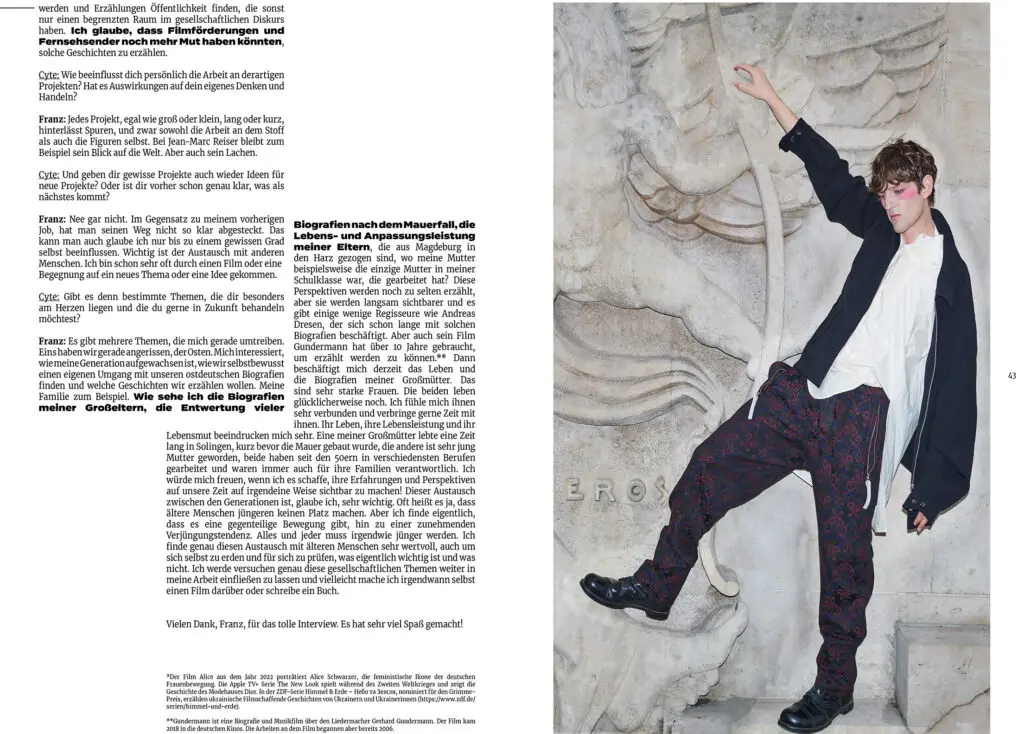
Franz Liebig

Actor: Franz Liebig
Words: Claudia Ippen

Photograph: Stephan Ziehen
Styling+ Outfits: von Uwe
Grooming: Mily Serebrenik@Bigoudi
Productions-Assistance: Nina Virus