


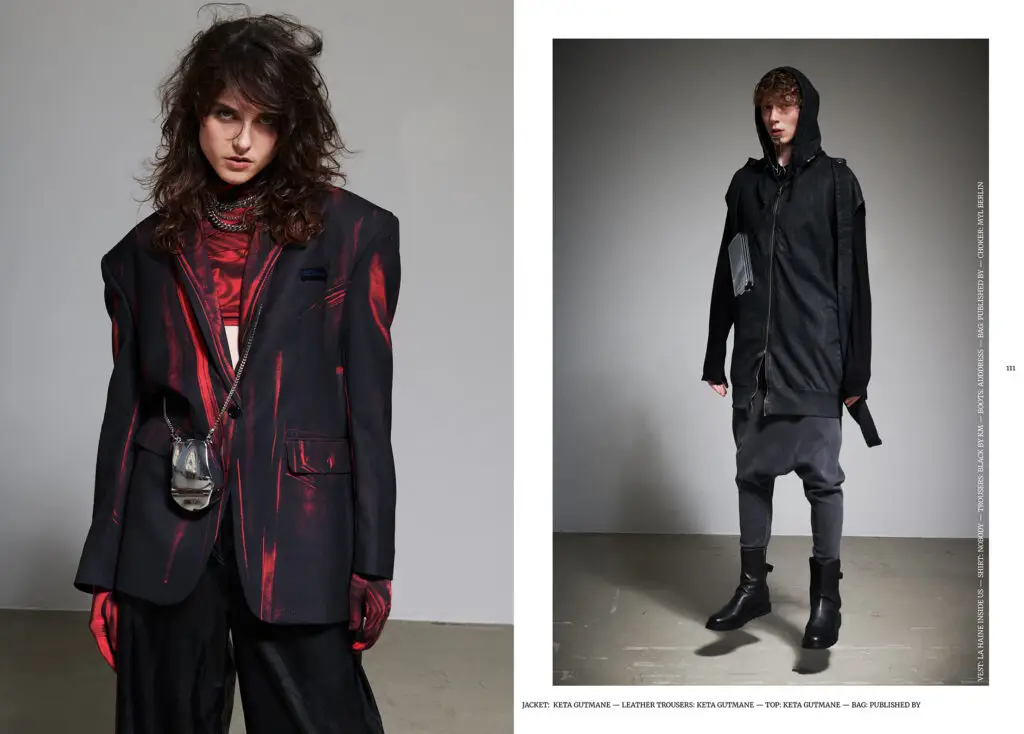

WHY AM I ME AND NOT YOU?
Photograph: Stephan Ziehen
Styling: Daniel Blechman
Hair: Jesus Rodriguez with products by Oribe
Make-Up: Natalia Soboleva@LigaNord
Models: Bastian@M4 models
Addie Sines@Modelwerk

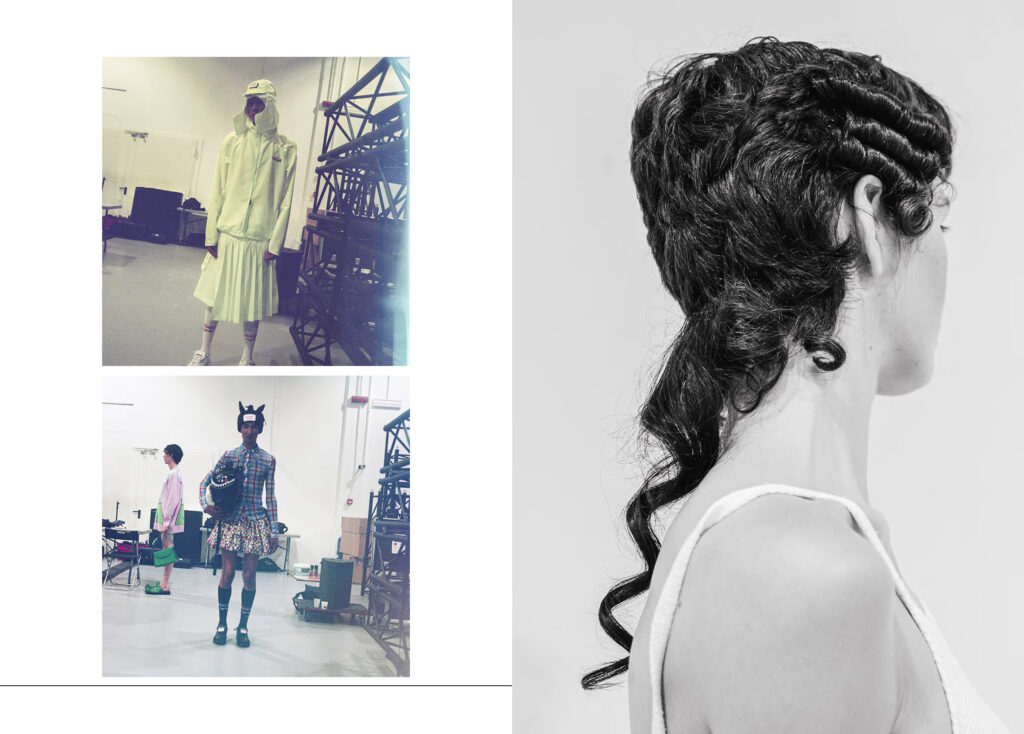
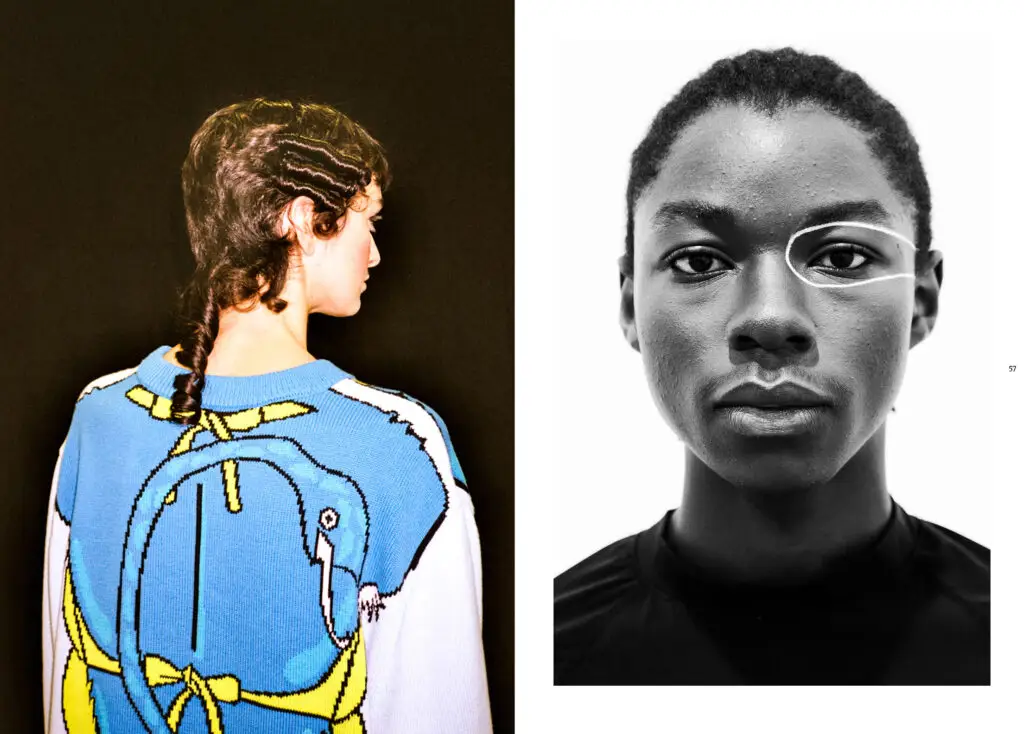
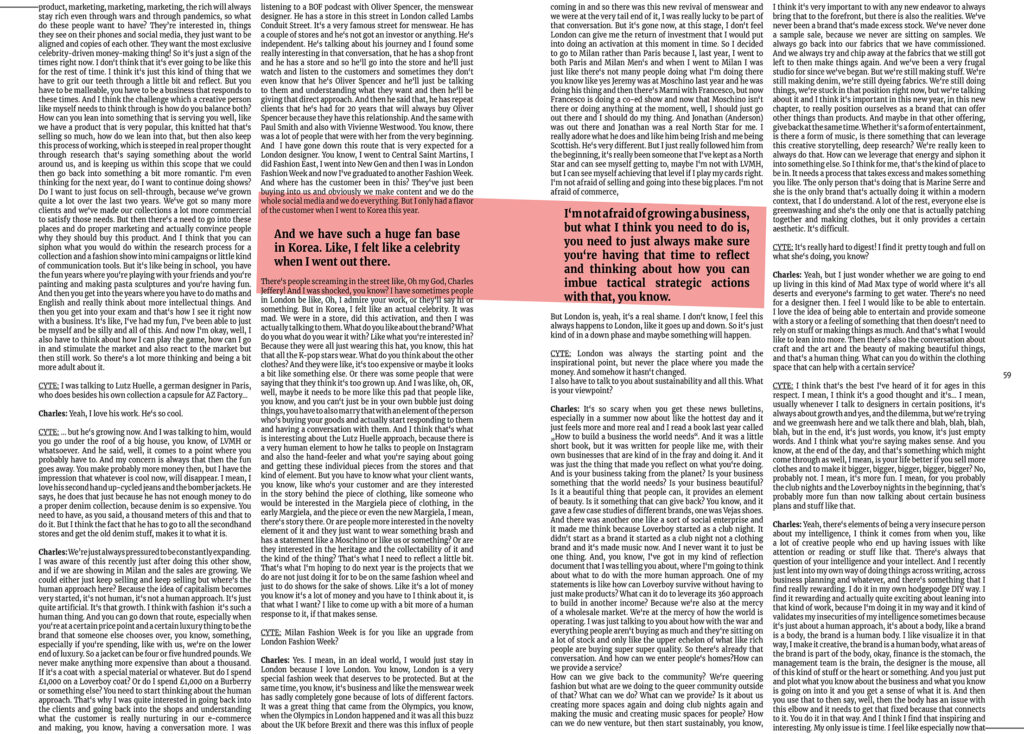
About club nights, monarchy and being Scottish – the wonderful world of Charles Jefferey
Talking to Charles is great fun! You feel his passion and enthusiasm in every word he says. And it is easy to imagine that his label „Loverboy“ started as a club night, which led then to the label, which we see now. The energy, the fun and his love for music comes through every fibre and in combination with his Scottish heritage, „Loverboy“ couldn’t look much different.
Also his new collection plays with all these elements, but also with his take on monarchy, caused by the death of the queen, the coronation of Charles and the general political turbulences in England. And if you stir in some queerness, you get an impression of his latest work.
CYTE: Congratulations to a fantastic show! I really like what you did! I’ve been a big fan since a while, especially since your fall 2021 collection, the „new romantics/punk“-collection, where I really got hooked to your work.
Charles. Thank you so much!
Cyte: Please tell me a bit about the new collection, what was your theme and what is the background?
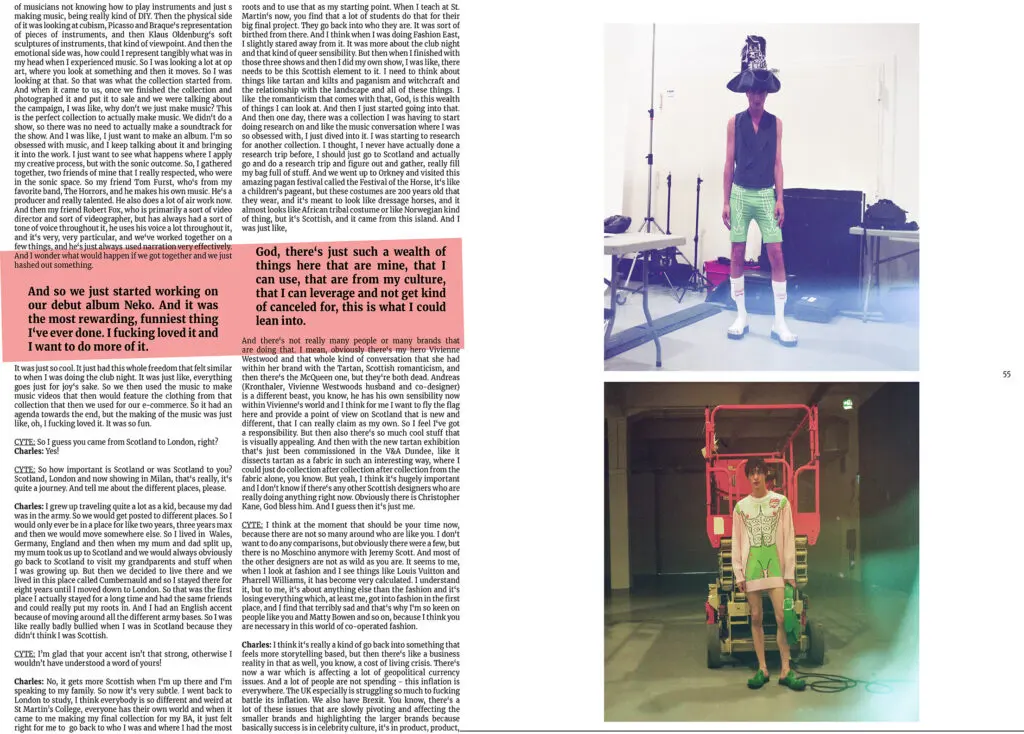
C: I started researching for the new collection in September last year, around that time when the queen died and it was also the beginning with all the turbulences in parliament. It was like thrust back into historic time, it was all kind of pomp and pageantry, the news was constantly about the queen for a really long time – we had a taste about it the year before, when Prince Philipp died, and then with the queen it was like that on steroids. Don’t get me wrong, some of the visuals I really liked as a creative person – the uniforms and everything else are really beautiful and also the tradition, which we have as a country, is quite interesting. With that matched and the political turbulence going on, with the government changing and the new prime minister, we didn’t had any saying and now also with the new king, where we didn’t have any saying. We are now in this new era – the Charles era – my name is Charles – so what is that new era, that we are in? It’s the Carolean era – what if we were „new caroleans“. I was really interested of a reclamation of that space. I guess queerness is a reclamation of a certain kind of space, whether it is in club spaces, identity spaces or political rights. It’s always this idea of going against the grain and reclaiming a space for your own or language and things like that. So, I was, ok let’s try a new sensibility, let’s provide a new race of people or a new counterculture, called these „new caroleans“. This was sort of the initial starting point. And then I thought what are the visual elements I can start playing with to articulate this vision? So, when this is the „new caroleans“-era, what was the „past- caroleans“-era, what was the last one we were in. And it was in the 17th century with King Charles II and that was also a great reclamation, it was literally called the „great reclamation“ and it was all about the reclamation of the monarchy in contrast of a time when they were against the arts and anything creative, a form of christianity, when Britain was a kind of republic, where things were very stale and not very beautiful. So, I started looking at the 17th century dress specifically .That kind of doublets ,breeches and lace collar detailing, some of the architectures ,this kind of opulentness. So I how can I balance that with that idea of a counterculture and I started looking at my favorite counterculture, which is the „new romantics“.Which always something I like to go back to. But I wanted to go and find new images, cause there is so many which are used all of the time, and I really wanted to find some new specific, more public images. There is a great place in London called the „museum of youth culture“, which is a online database, that is user generated, so people send in there images, their own house, home images and the museum than tags it.
There are people from Bristol or Portsmouth or Brecon in Wales and they send in there images of them from like 1979 or early eighties, maybe with a little theatre collar but like a t-shirt, you know what i mean, with something really interesting…so I looked at that and I was also interested in that idea of wellness and running and exercises as being a form of a utopian thing as well. I mashed all those elements through an AI generator to create new images. So ,that’s how I started it with regards of research, reclaiming our space, using technology to create images and depicting a sort of utopia which we took from the monarchy, but then reformatted it in a way that felt a bit more public, subcultural and then aligned with wellness and sort of sports. So that was the research. So it’s a really long answer to your question.
CYTE: Brilliant.
You were mentioning quite often, not only now, but also before in interviews I read, queer fashion, and that’s been a word which has been used quite often now. How would you differentiate queer fashion to straight or regular fashion? Would you differentiate that? I mean, how would you characterize that?
Charles: Well, I think it’s always about going against something, it’s maybe like a form of punk or anarchy, you could say, but I think it’s very much steeped within the LGBT sort of thrashed around, especially when I started as a designer. But I see it as a sort of full exercise, you know, like, okay, how can you queer something? Okay, well, disintegrate it, and then you apply or imbue it with a sort of LGBT viewpoint, that then means that the people that are participating in that space feel that it represents who they are. So it’s in a visual way, it’s like a solid thing and it becomes really fluid. And then it turns into a whole new shape, but a shape that means that an LGBT viewpoint is taken on board, basically. So it can be as loose or as specific as you like it to be, really. And I think if you are seeing it in relation to straight fashion, I would say that straight fashion is always there’s so much culture that’s there that already exists that people regurgitate and view things in and it’s maybe more of a direct take, whereas the queer one will always either shoehorn in an LGBT viewpoint or it will mold it to fit it, if that makes sense. That’s how I see it.
CYTE: If I understand you right, I mean, if I exaggerate that, that straight fashion is more boring, and queer fashion is just more colorful and vibrant, in a way.
Charles: I guess, yeah, the results of queer fashion is definitely within those spaces, but I think there’s a lot more designers that are participating and I guess that sort of process of designing and thinking and marketing, it’s got a bit where, it’s weirdly got a bit watered down or sort of become this weird buzz word to justify certain designers‘ marketing agenda – which is fine. But I wouldn’t say that it means that straight fashion is boring. I think that it’s just a different way, and a different way in of designing fashion. You know, there’s lots of different approaches, and I think a queer, when you’re queering, or working in a queer point of view, it’s as I say, it’s about just always centering LGBT people’s existences within the work, and then moulding something around it, and then you can be playful and subversive and audacious, all of those kinds of things. But straight fashion can be all of those things as well, but I think it’s then catering more to the show and get some pieces on the website as well.
CYTE: Music seems to be quite important to you and also to the show and bits and pieces on the website as well. Where does that come from?
Charles: Loverboy started as a club night, so you know, one could argue that it’s always been part of music and music was where it kind of started, bringing people together in a space, playing music and then a culture comes from that. And whenever I would be making the shows and working with somebody who would be doing the show soundtrack, I could literally be right with them the whole way through, like exactly what I wanted in every single part of it. And I’m lucky that I’ve got a lot of patient musician friends who can deal with that. And I just found myself knowing specifically so much what I wanted, I would want this particular BPM or I’d want this beat from this thing with that kind of thing over the top of it, and then I did this collection where I want to honour this obsession that I have with the music. Because I also would get all of my ideas for the show or where I’d want to go with the research through walking to work and listening to music. So that’s like my safe space, it’s where I get all of my hopes and dreams from. The whole point of walking or running and listening to music, it’s just such an amazing thing, it’s like putting a cinema on in your mind, you know, you’re just sitting and clashing everything together. So I just wanted to do a collection that represents that. So I looked at 1979 specifically, it’s my favourite time in music and fashion and art. I looked at the no wave movement in New York because I love the idea of musicians not knowing how to play instruments and just s making music, being really kind of DIY. Then the physical side of it was looking at cubism, Picasso and Braque’s representation of pieces of instruments, and then Klaus Oldenburg’s soft sculptures of instruments, that kind of viewpoint. And then the emotional side was, how could I represent tangibly what was in my head when I experienced music. So I was looking a lot at op art, where you look at something and then it moves. So I was looking at that. So that was what the collection started from. And when it came to us, once we finished the collection and photographed it and put it to sale and we were talking about the campaign, I was like, why don’t we just make music? This is the perfect collection to actually make music. We didn’t do a show, so there was no need to actually make a soundtrack for the show. And I was like, I just want to make an album. I’m so obsessed with music, and I keep talking about it and bringing it into the work. I just want to see what happens where I apply my creative process, but with the sonic outcome. So, I gathered together, two friends of mine that I really respected, who were in the sonic space. So my friend Tom Furst, who’s from my favorite band, The Horrors, and he makes his own music. He’s a producer and really talented. He also does a lot of air work now. And then my friend Robert Fox, who is primarily a sort of video director and sort of videographer, but has always had a sort of tone of voice throughout it, he uses his voice a lot throughout it, and it’s very, very particular, and we’ve worked together on a few things, and he’s just always used narration very effectively. And I wonder what would happen if we got together and we just hashed out something. And so we just started working on our debut album Neko. And it was the most rewarding, funniest thing I’ve ever done. I fucking loved it and I want to do more of it. It was just so cool. It just had this whole freedom that felt similar to when I was doing the club night. It was just like, everything goes just for joy’s sake. So we then used the music to make music videos that then would feature the clothing from that collection that then we used for our e-commerce. So it had an agenda towards the end, but the making of the music was just like, oh, I fucking loved it. It was so fun.
CYTE: So I guess you came from Scotland to London, right?
Charles: Yes!
CYTE: So how important is Scotland or was Scotland to you? Scotland, London and now showing in Milan, that’s really, it’s quite a journey. And tell me about the different places, please.
Charles: I grew up traveling quite a lot as a kid, because my dad was in the army. So we would get posted to different places. So I would only ever be in a place for like two years, three years max and then we would move somewhere else. So I lived in Wales, Germany, England and then when my mum and dad split up, my mum took us up to Scotland and we would always obviously go back to Scotland to visit my grandparents and stuff when I was growing up. But then we decided to live there and we lived in this place called Cumbernauld and so I stayed there for eight years until I moved down to London. So that was the first place I actually stayed for a long time and had the same friends and could really put my roots in. And I had an English accent because of moving around all the different army bases. So I was like really badly bullied when I was in Scotland because they didn’t think I was Scottish.
CYTE: I’m glad that your accent isn’t that strong, otherwise I wouldn’t have understood a word of yours!
Charles: No, it gets more Scottish when I’m up there and I’m speaking to my family. So now it’s very subtle. I went back to London to study, I think everybody is so different and weird at St Martin’s College, everyone has their own world and when it came to me making my final collection for my BA, it just felt right for me to go back to who I was and where I had the most roots and to use that as my starting point. When I teach at St. Martin’s now, you find that a lot of students do that for their big final project. They go back into who they are. It was sort of birthed from there. And I think when I was doing Fashion East, I slightly stared away from it. It was more about the club night and that kind of queer sensibility. But then when I finished with those three shows and then I did my own show, I was like, there needs to be this Scottish element to it. I need to think about things like tartan and kilts and paganism and witchcraft and the relationship with the landscape and all of these things. I like the romanticism that comes with that, God, is this wealth of things I can look at. And then I just started going into that. And then one day, there was a collection I was having to start doing research on and like the music conversation where I was so obsessed with, I just dived into it. I was starting to research for another collection. I thought, I never have actually done a research trip before, I should just go to Scotland and actually go and do a research trip and figure out and gather, really fill my bag full of stuff. And we went up to Orkney and visited this amazing pagan festival called the Festival of the Horse, it’s like a children’s pageant, but these costumes are 200 years old that they wear, and it’s meant to look like dressage horses, and it almost looks like African tribal costume or like Norwegian kind of thing, but it’s Scottish, and it came from this island. And I was just like, God, there’s just such a wealth of things here that are mine, that I can use, that are from my culture, that I can leverage and not get kind of canceled for, this is what I could lean into. And there’s not really many people or many brands that are doing that. I mean, obviously there’s my hero Vivienne Westwood and that whole kind of conversation that she had within her brand with the Tartan, Scottish romanticism, and then there’s the McQueen one, but they’re both dead. Andreas (Kronthaler, Vivienne Westwoods husband and co-designer) is a different beast, you know, he has his own sensibility now within Vivienne’s world and I think for me I want to fly the flag here and provide a point of view on Scotland that is new and different, that I can really claim as my own. So I feel I’ve got a responsibility. But then also there’s so much cool stuff that is visually appealing. And then with the new tartan exhibition that’s just been commissioned in the V&A Dundee, like it dissects tartan as a fabric in such an interesting way, where I could just do collection after collection after collection from the fabric alone, you know. But yeah, I think it’s hugely important and I don’t know if there’s any other Scottish designers who are really doing anything right now. Obviously there is Christopher Kane, God bless him. And I guess then it’s just me.
CYTE: I think at the moment that should be your time now, because there are not so many around who are like you. I don’t want to do any comparisons, but obviously there were a few, but there is no Moschino anymore with Jeremy Scott. And most of the other designers are not as wild as you are. It seems to me, when I look at fashion and I see things like Louis Vuitton and Pharrell Williams, it has become very calculated. I understand it, but to me, it’s about anything else than the fashion and it’s losing everything which, at least me, got into fashion in the first place, and I find that terribly sad and that’s why I’m so keen on people like you and Matty Bowen and so on, because I think you are necessary in this world of co-operated fashion.
Charles: I think it’s really a kind of go back into something that feels more storytelling based, but then there’s like a business reality in that as well, you know, a cost of living crisis. There’s now a war which is affecting a lot of geopolitical currency issues. And a lot of people are not spending – this inflation is everywhere. The UK especially is struggling so much to fucking battle its inflation. We also have Brexit. You know, there’s a lot of these issues that are slowly pivoting and affecting the smaller brands and highlighting the larger brands because basically success is in celebrity culture, it’s in product, product, product, marketing, marketing, marketing, the rich will always stay rich even through wars and through pandemics, so what do these people want to have? They’re interested in, things they see on their phones and social media, they just want to be aligned and copies of each other. They want the most exclusive celebrity-driven money-making thing! So it’s just a sign of the times right now. I don’t think that it’s ever going to be like this for the rest of time. I think it’s just this kind of thing that we have to grit our teeth through a little bit and reflect. But you have to be malleable, you have to be a business that responds to these times. And I think the challenge which a creative person like myself needs to think through is how do you balance both? How can you lean into something that is serving you well, like we have a product that is very popular, this knitted hat that’s selling so much, how do we lean into that, but then also keep this process of working, which is steeped in real proper thought through research that’s saying something about the world around us, and is keeping us within this scope that we could then go back into something a bit more romantic. I’m even thinking for the next year, do I want to continue doing shows? Do I want to just focus on sell-through, because we’ve grown quite a lot over the last two years. We’ve got so many more clients and we’ve made our collections a lot more commercial to satisfy those needs. But then there’s a need to go into these places and do proper marketing and actually convince people why they should buy this product. And I think that you can siphon what you would do within the research process for a collection and a fashion show into mini campaigns or little kind of communication tools. But it’s like being in school, you have the fun years where you’re playing with your friends and you’re painting and making pasta sculptures and you’re having fun. And then you get into the years where you have to do maths and English and really think about more intellectual things. And then you get into your exam and that’s how I see it right now with a business. It’s like, I’ve had my fun, I’ve been able to just be myself and be silly and all of this. And now I’m okay, well, I also have to think about how I can play the game, how can I go in and stimulate the market and also react to the market but then still work. So there’s a lot more thinking and being a bit more adult about it.
CYTE: I was talking to Lutz Huelle, a german designer in Paris, who does besides his own collection a capsule for AZ Factory…
Charles: Yeah, I love his work. He’s so cool.
CYTE: … but he’s growing now. And I was talking to him, would you go under the roof of a big house, you know, of LVMH or whatsoever. And he said, well, it comes to a point where you probably have to. And my concern is always that then the fun goes away. You make probably more money then, but I have the impression that whatever is cool now, will disappear. I mean, I love his second hand up-cycled jeans and the bomber jackets. He says, he does that just because he has not enough money to do a proper denim collection, because denim is so expensive. You need to have, as you said, a thousand meters of this and that to do it. But I think the fact that he has to go to all the secondhand stores and get the old denim stuff, makes it to what it is.
Charles: We’re just always pressured to be constantly expanding. I was aware of this recently just after doing this other show, and if we are showing in Milan and the sales are growing. We could either just keep selling and keep selling but where’s the human approach here? Because the idea of capitalism becomes very started, it’s not human, it’s not a human approach. It’s just quite artificial. It’s that growth. I think with fashion it’s such a human thing. And you can go down that route, especially when you’re at a certain price point and a certain luxury thing to be the brand that someone else chooses over, you know, something, especially if you’re spending, like with us, we’re on the lower end of luxury. So a jacket can be four or five hundred pounds. We never make anything more expensive than about a thousand. If it’s a coat with a special material or whatever. But do I spend £1,000 on a Loverboy coat? Or do I spend £1,000 on a Burberry or something else? You need to start thinking about the human approach. That’s why I was quite interested in going back into the clients and going back into the shops and understanding what the customer is really nurturing in our e-commerce and making, you know, having a conversation more. I was listening to a BOF podcast with Oliver Spencer, the menswear designer. He has a store in this street in London called Lambs Conduit Street. It’s a very famous street for menswear. He has a couple of stores and he’s not got an investor or anything. He’s independent. He’s talking about his journey and I found some really interesting in that conversation, that he has a shop front and he has a store and so he’ll go into the store and he’ll just watch and listen to the customers and sometimes they don’t even know that he’s Oliver Spencer and he’ll just be talking to them and understanding what they want and then he’ll be giving that direct approach. And then he said that, he has repeat clients that he’s had for 20 years that will always buy Oliver Spencer because they have this relationship. And the same with Paul Smith and also with Vivienne Westwood. You know, there was a lot of people that were with her from the very beginning. And I have gone down this route that is very expected for a London designer. You know, I went to Central Saint Martins, I did Fashion East, I went into New Gen and then I was in London Fashion Week and now I’ve graduated to another Fashion Week. And where has the customer been in this? They’ve just been buying into us and obviously we make content and we do the whole social media and we do everything. But I only had a flavor of the customer when I went to Korea this year. And we have such a huge fan base in Korea. Like, I felt like a celebrity when I went out there. There’s people screaming in the street like, Oh my God, Charles Jeffery! And I was shocked, you know? I have sometimes people in London be like, Oh, I admire your work, or they’ll say hi or something. But in Korea, I felt like an actual celebrity. It was mad. We were in a store, did this activation, and then I was actually talking to them. What do you like about the brand? What do you what do you wear it with? Like what you’re interested in? Because they were all just wearing this hat, you know, this hat that all the K-pop stars wear. What do you think about the other clothes? And they were like, it’s too expensive or maybe it looks a bit like something else. Or there was some people that were saying that they think it’s too grown up. And I was like, oh, OK, well, maybe it needs to be more like this pad that people like, you know, and you can’t just be in your own bubble just doing things, you have to also marry that with an element of the person who’s buying your goods and actually start responding to them and having a conversation with them. And I think that’s what is interesting about the Lutz Huelle approach, because there is a very human element to how he talks to people on Instagram and also the hand-feeler and what you’re saying about going and getting these individual pieces from the stores and that kind of element. But you have to know what your client wants, you know, like who’s your customer and are they interested in the story behind the piece of clothing, like someone who would be interested in the Margiela piece of clothing, in the early Margiela, and the piece or even the new Margiela, I mean, there’s story there. Or are people more interested in the novelty element of it and they just want to wear something brash and has a statement like a Moschino or like us or something? Or are they interested in the heritage and the collectability of it and the kind of the thing? That’s what I need to reflect a little bit. That’s what I’m hoping to do next year is the projects that we do are not just doing it for to be on the same fashion wheel and just to do shows for the sake of shows. Like it’s a lot of money you know it’s a lot of money and you have to I think about it, is that what I want? I like to come up with a bit more of a human response to it, if that makes sense.
CYTE: Milan Fashion Week is for you like an upgrade from London Fashion Week?
Charles: Yes. I mean, in an ideal world, I would just stay in London because I love London. You know, London is a very special fashion week that deserves to be protected. But at the same time, you know, it’s business and like the menswear week has sadly completely gone because of lots of different factors. It was a great thing that came from the Olympics, you know, when the Olympics in London happened and it was all this buzz about the UK before Brexit and there was this influx of people coming in and so there was this new revival of menswear and we were at the very tail end of it, I was really lucky to be part of that conversation. But it’s gone now, at this stage, I don’t feel London can give me the return of investment that I would put into doing an activation at this moment in time. So I decided to go to Milan rather than Paris because I, last year, I went to both Paris and Milan Men’s and when I went to Milan I was just like there’s not many people doing what I’m doing there you know like yes Jeremy was at Moschino last year and he was doing his thing and then there’s Marni with Francesco, but now Francesco is doing a co-ed show and now that Moschino isn’t there or doing anything at the moment, well, I should just go out there and I should do my thing. And Jonathan (Anderson) was out there and Jonathan was a real North Star for me. I really adore what he does and like him being Irish and me being Scottish. He’s very different. But I just really followed him from the beginning, it’s really been someone that I’ve kept as a North Star and can see myself getting to, maybe I’m not with LVMH, but I can see myself achieving that level if I play my cards right. I’m not afraid of selling and going into these big places. I’m not afraid of commerce, I’m not afraid of growing a business, but what I think you need to do is, you need to just always make sure you’re having that time to reflect and thinking about how you can imbue tactical strategic actions with that, you know. But London is, yeah, it’s a real shame. I don’t know, I feel this always happens to London, like it goes up and down. So it’s just kind of in a down phase and maybe something will happen.
CYTE: London was always the starting point and the inspirational point, but never the place where you made the money. And somehow it hasn’t changed.
I also have to talk to you about sustainability and all this. What is your viewpoint?
Charles: It’s so scary when you get these news bulletins, especially in a summer now about like the hottest day and it just feels more and more real and I read a book last year called „How to build a business the world needs“. And it was a little short book, but it was written for people like me, with their own businesses that are kind of in the fray and doing it. And it was just the thing that made you reflect on what you’re doing. And is your business taking from the planet? Is your business something that the world needs? Is your business beautiful? Is it a beautiful thing that people can, it provides an element of beauty. Is it something that can give back? You know, and it gave a few case studies of different brands, one was Vejas shoes. And there was another one like a sort of social enterprise and it made me think because Loverboy started as a club night. It didn’t start as a brand it started as a club night not a clothing brand and it’s made music now. And I never want it to just be one thing. And, you know, I’ve got in my kind of reflection document that I was telling you about, where I’m going to think about what to do with the more human approach. One of my statements is like how can Loverboy survive without having to just make products? What can it do to leverage its 360 approach to build in another income? Because we’re also at the mercy of a wholesale market. We’re at the mercy of how the world is operating. I was just talking to you about how with the war and everything people aren’t buying as much and they’re sitting on a lot of stock and only like the upper echelon of what like rich people are buying super super quality. So there’s already that conversation. And how can we enter people’s homes?How can we provide a service? How can we give back to the community? We’re queering fashion but what are we doing to the queer community outside of that? What can we do? What can we provide? Is it about us creating more spaces again and doing club nights again and making the music and creating music spaces for people? How can we do new venture, but then start sustainably, you know, I think it’s very important to with any new endeavor to always bring that to the forefront, but there is also the realities. We’ve never been a brand that’s made excess stock. We’ve never done a sample sale, because we never are sitting on samples. We always go back into our fabrics that we have commissioned. And we always try and chip away at the fabrics that we still got left to then make things again. And we’ve been a very frugal studio for since we’ve began. But we’re still making stuff. We’re still making denim, we’re still dyeing fabrics. We’re still doing things, we’re stuck in that position right now, but we’re talking about it and I think it’s important in this new year, in this new chapter, to really position ourselves as a brand that can offer other things than products. And maybe in that other offering, give back at the same time. Whether it’s a form of entertainment, is there a form of music, is there something that can leverage this creative storytelling, deep research? We’re really keen to always do that. How can we leverage that energy and siphon it into something else. So I think for me, that’s the kind of place to be in. It needs a process that takes excess and makes something you like. The only person that’s doing that is Marine Serre and she is the only brand that’s actually doing it within a modern context, that I do understand. A lot of the rest, everyone else is greenwashing and she’s the only one that is actually patching together and making clothes, but it only provides a certain aesthetic. It’s difficult.
CYTE: It’s really hard to digest! I find it pretty tough and full on what she’s doing, you know?
Charles: Yeah, but I just wonder whether we are going to end up living in this kind of Mad Max type of world where it’s all deserts and everyone’s farming to get water. There’s no need for a designer then. I feel I would like to be able to entertain. I love the idea of being able to entertain and provide someone with a story or a feeling of something that then doesn’t need to rely on stuff or making things as much. And that’s what I would like to lean into more. Then there’s also the conversation about craft and the art and the beauty of making beautiful things, and that’s a human thing. What can you do within the clothing space that can help with a certain service?
CYTE: I think that’s the best I’ve heard of it for ages in this respect. I mean, I think it’s a good thought and it’s… I mean, usually whenever I talk to designers in certain positions, it’s always about growth and yes, and the dilemma, but we’re trying and we greenwash here and we talk there and blah, blah, blah, blah, but in the end, it’s just words, you know, it’s just empty words. And I think what you’re saying makes sense. And you know, at the end of the day, and that’s something which might come through as well, I mean, is your life better if you sell more clothes and to make it bigger, bigger, bigger, bigger, bigger? No, probably not. I mean, it’s more fun. I mean, for you probably the club nights and the Loverboy nights in the beginning, that’s probably more fun than now talking about certain business plans and stuff like that.
Charles: Yeah, there’s elements of being a very insecure person about my intelligence, I think it comes from when you, like a lot of creative people who end up having issues with like attention or reading or stuff like that. There’s always that question of your intelligence and your intellect. And I recently just lent into my own way of doing things across writing, across business planning and whatever, and there’s something that I find really rewarding. I do it in my own hodgepodge DIY way. I find it rewarding and actually quite exciting about leaning into that kind of work, because I’m doing it in my way and it kind of validates my insecurities of my intelligence sometimes because it’s just about a human approach, it’s about a body, like a brand is a body, the brand is a human body. I like visualize it in that way, I make it creative, the brand is a human body, what areas of the brand is part of the body, okay, finance is the stomach, the management team is the brain, the designer is the mouse, all of this kind of stuff or the heart or something. And you just put and plot what you know about the business and what you know is going on into it and you get a sense of what it is. And then you use that to then say, well, then the body has an issue with this elbow and it needs to get that fixed because that connects to it. You do it in that way. And I think I find that inspiring and interesting. My only issue is time. I feel like especially now that my team has grown and my job is where it is, I just don’t have as much time as I would like to be able to do everything that I want to do to the standard. When there’s a will, there’s a way. But I do worry sometimes about this, like next, these steps that might happen if I choose to do it or not, like whether where I will be with my happiness. Like I’ve been sober now for over a year and I feel so good about my brain and everything. And I’m a lot happier, but there’s still a space where I miss just fucking taking ecstasy and going dancing and drinking wine and everything. And I’m just like, but I’ve given up that so I can have a clear head so I can be like a good version of myself for my business, for my team. I don’t know why I’m getting to with my point, but I worry what will happen if I end up taking on another thing and then I’m like not even able to do the music or the da da da you know, because that’s the fun stuff but the money would be good, but that’s not because that completely contrasts what we were talking about you know.
CYTE: In the end I have a little thing which I called word games.
Charles: Oh lovely.
CYTE: I just say a word and you just give me a statement or sentence or two words to it.
FAMILY.
Charles: Supportive, wild, up and down.
MONEY.
Charles: I would say the same thing, no I won’t do that. Money is strange, delightful, mysterious.
HOME.
Charles: Home is cleanliness, consistency, and safety.
LOVE.
Charles: All-consuming, mysterious, terrifying.
CYTE: Finally, what’s your state of mind right now?
Charles. I feel very connected to the universe today, I feel strange psychic,
weirdly emotional, I don’t know why. That’s what I feel like today.
CYTE: Great, I think we got it now. It was really nice talking to you. I really enjoyed that.
Thank you so much! Have a great day and a nice weekend!
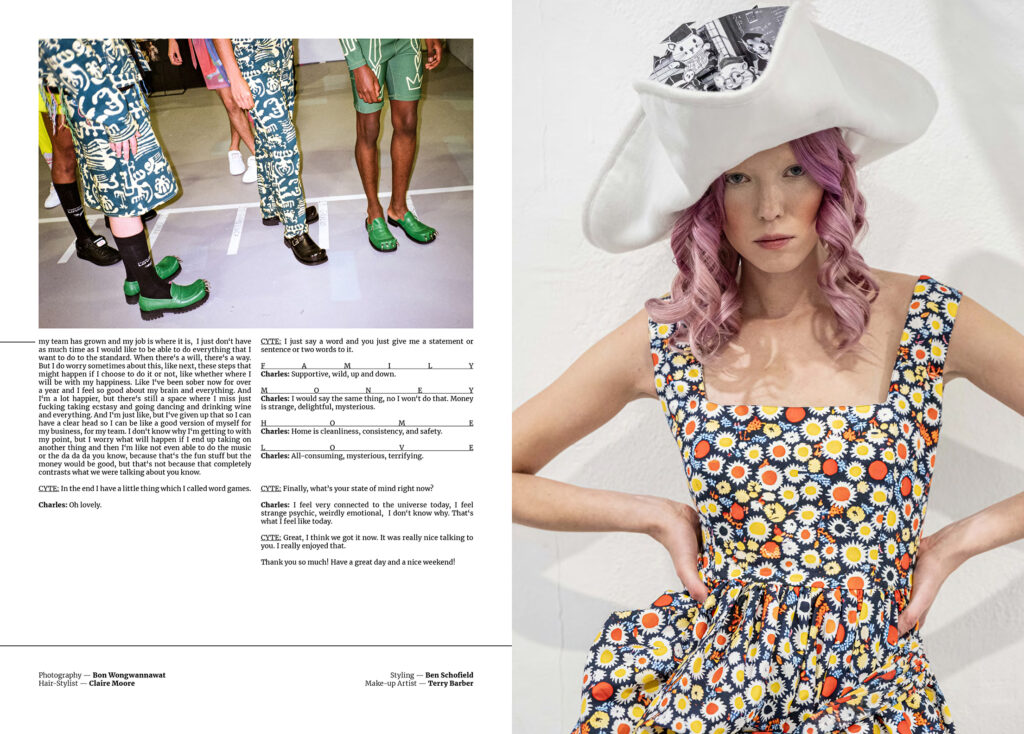
Photograph: Bon Wongwannawat
Stylist: Ben Schofield
Hair Stylist: Claire Moore
Makeup Artist: Terry Barber


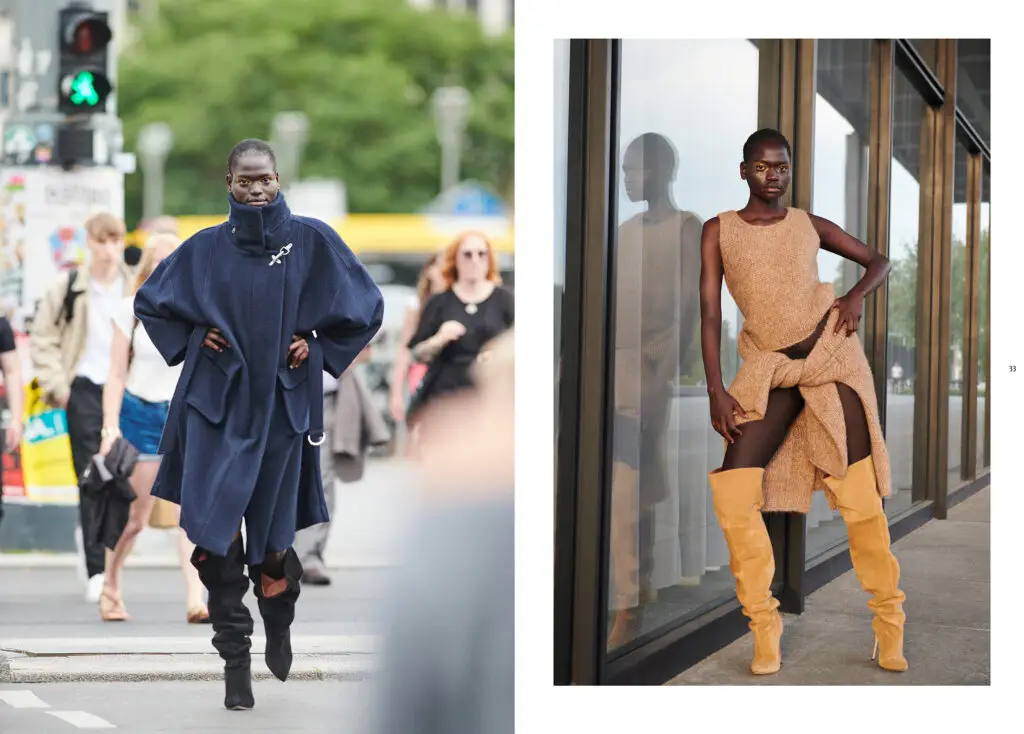
THE NOW CHIC
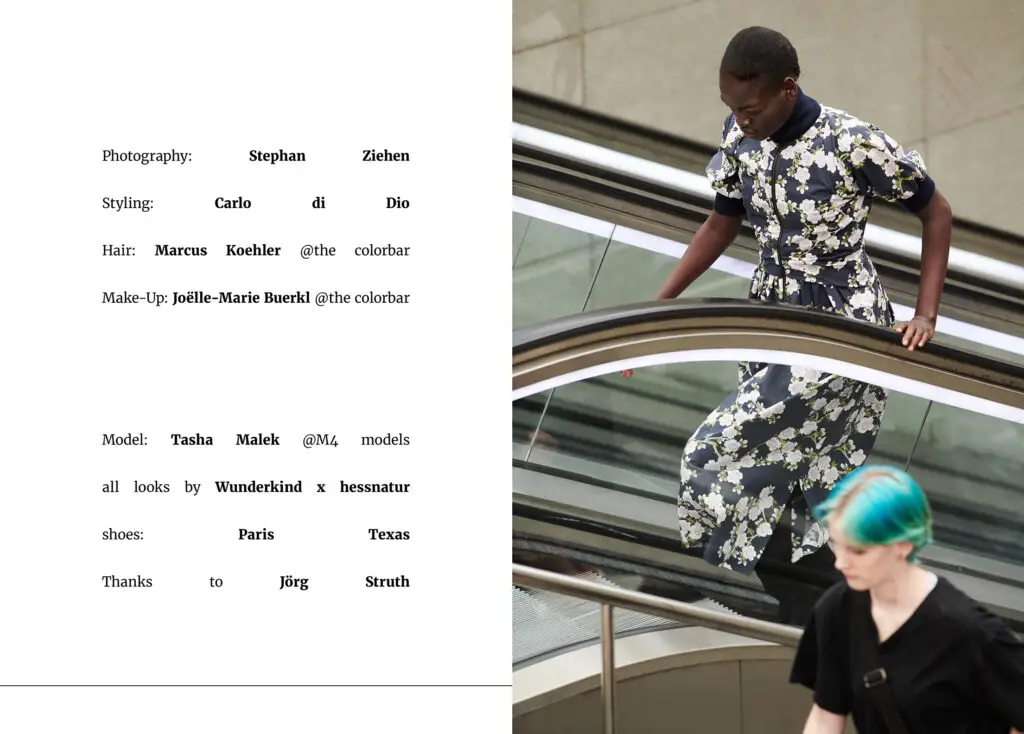
Photograph. Stephan Ziehen
Styling: Carlo di Dio
Hair: Marcus Koehler@the colorbar
Make-Up: Joëlle-Marie Buerkl@the colorbar
Model: Tasha Malek@M4 models
all looks by Wunderkind x hessnatur
shoes: Paris Texas
Thanks to Jörg Struth

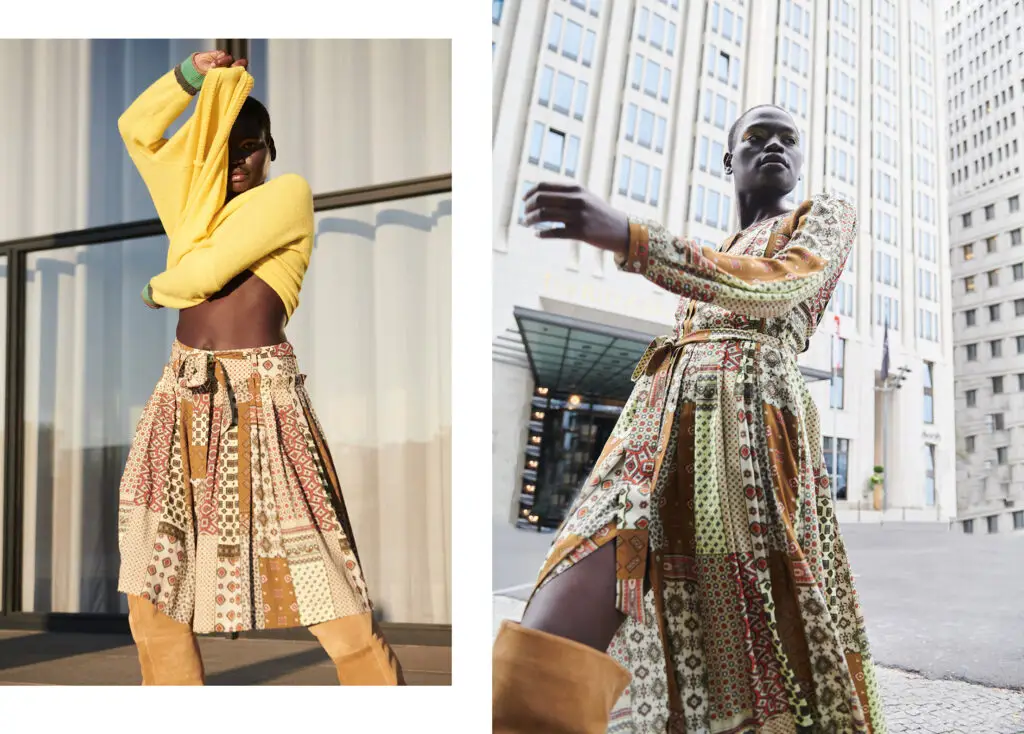
Shirt Balenciaga, pants The Attico, shoes Birckenstock, jacket Magda Butrym


Jaket and skirt Emilio Pucci, boots Balenciaga


Pants Darkpark, shirt Alaia
Body Alaia, pants Coperni, shoes + jacket Courreges

Bomber Balenciaga, skirt The Attico

Corset Magda Butrym, bracelet Balmain
Photograph: Uwe Körner
Model: Anna Shi@Tigers
Styling: Romina Schoene
Hair+Make-Up: Sven Ohlsen
Retouch/AI: Döss Realisation
Casting: Karen Stehle
Studio: Buddy Rental
Thank you: Emerson Renaldi


Who are you? What’s your profession?Gideon Rubin, I’m A London based painter. Why are you interested in sustainability?I’m a bit like a hoarder so it helps I don’t throw anything away. much prefer re-using, to re-appropriate. i collect old photos, toys etc… For years I’ve been painting on little cardboards, I just cut up used boxes to small pieces and paint over them with gauche colours. I love the feeling of making something quite precious out of the most mundane, throw away stuff. And what made change your mind?
Age, and seeing where we at. it a very different perspective.. What has to change – in your opinion – to make this world a better place?People. I don’t think it about how long humanity lasts, its under what conditions, what kind of life we want to have. We have to find a way to work together, individually, as industries, countries – think and act on it globally but we are so far from it.Energy-crisis, war, covid, populism. Do you still watch the news? Much less then i used to, still read the papers but keeping to the headlines, i skim through the rest. I figured reading more news doesn’t help me understandanything better really…Who is your idol?So many artists, musicians, writers, poets that make life much more bearable. State of mind?’Inspiration exists, but it has to find you working’ Picasso.
Who are you?Jean-Pierre BraganzaWhat’s your profession?Fashion Designer (@Coverlette) zero-waste menswear brand.Why are you interested in sustainability?It’s just so sad and depressing to think that we could slip into self-destruction and lose so much of the beauty and diversity of life out of sheer laziness and greed. I hope that humanity is better than that and we can shift our behaviour and force corporations to behave differently in time.And what made change your mind?Over the last few decades fashion became something disposable, a completely pointless cycle of trends and status. The value and appreciation of design and craftsmanship was lost. Trying to bring back a tiny bit of that consideration is why I started the Coverlette brand. I could only bear to work with existing vintage pieces and textiles, working with the constraints of the utilitarian design of military garments, and bringing the incredible artistry of the hand-woven antique coverlets back to life by combining them.What has to change – in your opinion – to make this world a better place?Corporations have to be held responsible for the pollution and garbage that they create. Why do we allow them to create endless plastic packaging and toxins that invade the water and air? Anything that comes in plastic should have a heavy tax added, with all of the revenue going to clean up waterways.Energy-crisis, war, covid, populism. Do you still watch the news?Yes every morning. Probably not a healthy habit.Who is your idol?Henry Rollins and Maynard James KeenanState of mind?Comfortably numb.

Who are you? What is your profession?
I am Izzet Ers, a London based fashion designer and artist with a Turkish Jewish background. I just launched Imago (@imago.circle), an up-cycle fashion collective and am one half of The Sinistry, a contemporary art partnership with the artist Bert Gilbert (@thesinistry).Why are you interested in sustainability? And what made you change your mind?I have always had an interest in textiles and other materials from the past, as they all carry within them their own story. Through my work in the fashion industry over the last twenty years and witnessing the monstrous amount of overproduction and waste, I’ve come to the realisation that one’s creativity has to be the most precious feature in this kind of work as it’s the only thing in this life that comes from a truly inexhaustible source.What has to change – in your opinion – to make this world a better place?I feel that there is an over-valuation of growth in general, creating new things with new materials in a never ending and self-consuming cycle, and it’s time to break this. Energy-crisis, war, covid, populism. Do you still watch the news?I don’t watch the news but I keep informed in other ways.Who is your idol?Carl JungState of mind?One of the mantras from The Sinistry’s Game of Life Manifesto gives an answer to this:Be uncontainable yet sustainable!

Who are you?Jade McSorley, a sustainable fashion advocate and fashion futurist. What’s your profession?I am the co-founder of LOANHOOD, a fashion rental community supporting emerging designers, independent brands and just really cool wardrobes. I am also a model of 15 years and undergoing my PhD on digital fashion and sustainability at the University of Creative Arts. Why are you interested in sustainability?I guess working as model for so long and working for a lot of fast fashion brands allows you to see the industry from such a unique perspective. I could see the rise in production and the decrease in quality and soon found it didn’t sit well with me as a person in the industry promoting and selling more clothes. I got interested in sustainability as I wanted to find a way to love fashion but without the guilt associated with consuming in a world that is affected by climate change. I ended up going back to study my MA in Fashion Futures at London College of Fashion that explored the complexities of sustainability
within a fashion context. I found it both scary and uplifting as I came to see sustainability as an opportunity for fashion to reset, to be more creative, less impactful to our planet and more beneficial to people and communities. And that is what we strive to do at LOANHOODAnd what made change your mind?Same as aboveWhat has to change – in your opinion – to make this world a better place?I think, from a top-down approach, government needs to make some big changes if we are going to really speed up change. They understand and do too little and I worry they will act when it is too late. Many will argue it is already too late. But I also think it is important to never underestimate the power of the consumer. Instead of waiting for government to step in, there is so much that we can do as individuals and make different choices. If we as consumers speak up, industry and government will have to listen! So I would say to anyway who wants to go a buy a new outfit for a new week, first think about whether you need it, and then think about alternative ways in which you can get it – resale, rental, borrow from friends and family – there are so many amazing businesses out there are sustainably driven and as consumers we need to support them. Energy-crisis, war, covid, populism. Do you still watch the news?I think it is important to know what is going on in the world and affecting the people of our planet. However, I think, like most people, I find it hard to watch and stay positive throughout the day. I have stopped watching the news on the morning first-thing but I will keep aware of what’s going on through different media channels throughout the day. I don’t want to be ignorant to those that are going through such challenging times and I think more than ever we need to be there for each other. Who is your idol?Oh, there are many amazing people in the world who inspire me and keep me going. Alexandria Ocasio-Cortez is a force to be reckoned with and I find her so be insightful, empathetic, and articulate in the way she addresses those in power. David Attenborough for reminding us about the beauty of nature. And Iris Apfel for reminding us about the fabulousness of fashion.State of mind?In flux! Sometimes I feel anxious about the world and where we are heading and then the next minute, I am full of positivity and feel like we can create change.
The Coverlette brand is one-of-a-kind clothing created in London from vintage garments + antique textiles. After running a ready-to-wear brand for 12 years in London, Jean-Pierre Braganza was tired of the cycle of seasonal wholesale fashion and needed to find a way to focus on his true passion; design. The lockdown of 2020 brought a new, enforced slowness, and at this point he discovered the incredible beauty of antique coverlets. Loomed in the 17th and 18th centuries by European settlers in North America, the stories of these people are often told through the images woven into the fabric. Finding a way to bring this incredible craftsmanship back to life turned into the Coverlette brand. Antiques that may have been packed in an attic have been transformed into a unique and meaningful piece, meant to be worn, loved and kept forever.
Who are you? What’s your profession?Gideon Rubin, I’m A London based painter. Why are you interested in sustainability?I’m a bit like a hoarder so it helps I don’t throw anything away. much prefer re-using, to re-appropriate. i collect old photos, toys etc… For years I’ve been painting on little cardboards, I just cut up used boxes to small pieces and paint over them with gauche colours. I love the feeling of making something quite precious out of the most mundane, throw away stuff. And what made change your mind?
Age, and seeing where we at. it a very different perspective.. What has to change – in your opinion – to make this world a better place?People. I don’t think it about how long humanity lasts, its under what conditions, what kind of life we want to have. We have to find a way to work together, individually, as industries, countries – think and act on it globally but we are so far from it.Energy-crisis, war, covid, populism. Do you still watch the news? Much less then i used to, still read the papers but keeping to the headlines, i skim through the rest. I figured reading more news doesn’t help me understandanything better really…Who is your idol?So many artists, musicians, writers, poets that make life much more bearable. State of mind?’Inspiration exists, but it has to find you working’ Picasso


MEHR MACHT DEN ARTISTS!
Steht uns eine Revolution bevor?! Die Zukunft des Musik Business im Web3.
In der Musikindustrie hat sich in den letzten Jahren viel verändert. Durch fortschreitende technologische Möglichkeiten und die Nutzung dezentraler Strukturen im Web3-Ökosystem, können Musikprodukte und -dienstleistungen auf neuartige Weise angeboten und konsumiert werden, mit deutlichen Vorteilen für Künstler und ihr Schaffen.
Web1 – Lesen und Abrufen
Web2 – Lesen und Schreiben im bidirektionalen Austausch im Social Web
Web3 – Lesen, Schreiben und Besitzen
Aber der Reihe nach. Fangen wir mit ein paar Begriffserklärungen an. Web3 bezeichnet die dritte Generation des World Wide Web, die durch den Einsatz von Technologien wie Blockchain und Peer-to-Peer-Netzwerken ein dezentralisiertes, transparentes und sichereres Internet schaffen soll. Das Ziel von Web3 ist es, den Nutzern mehr Kontrolle über ihre persönlichen Daten, ihre Online-Identität und ihre digitalen Inhalte und Güter zu geben. Web3 stellt dabei eine bedeutende Abkehr von den vorherigen Generationen des Webs dar, die als Web1 und Web2 bekannt sind.
Im Web3 werden die Daten dezentral per Blockchain-Technologie auf einem Netzwerk von Computern gespeichert, anstatt auf zentralen Servern, die sich im Besitz einiger weniger großer Unternehmen befinden. User besitzen und kontrollieren also selbst ihre digitalen Assets, was den Bedarf an Zwischenhändlern überflüssig macht. Das Kreieren und Vertreiben von digitalen Gütern soll damit transparenter und fairer gestaltet sein.
Eine Blockchain ist eine besondere Form einer Datenbank, welche aus einer Reihe von miteinander verbundenen Unterdatenbanken, auch Blocks genannt, besteht. Jeder Block enthält nicht nur die zu speichernden Informationen, sondern auch einen eindeutigen Identifikator in Form eines Hash-Werts. Alle Blöcke innerhalb der Blockchain sind miteinander verknüpft und verfügen jeweils über die Kenntnis ihrer eigenen sowie der anderen Hash-Werte. Eine Manipulation von Daten innerhalb eines Blocks würde zu einer Veränderung des dazugehörigen Hash-Werts führen und somit auch die gesamte Blockchain unbrauchbar machen. Somit stellt die Blockchain ein wirksames Instrument dar, um Betrug und Manipulationen zu verhindern. BITTE QUELLE ANGEBEN
Web3 und NFTs (Non-Fungible Tokens) sind eng miteinander verbunden. NFTs stellen einzigartige digitale Marken dar, die nicht austauschbar sind und in der Blockchain gespeichert werden. Jeder NFT ist speziell an einen bestimmten realen oder digitalen Vermögens-/Wertgegenstand gebunden und dient als eine Art Besitzurkunde, aber nicht als der Gegenstand selbst. In den letzten Jahren hat die Verwendung von NFTs im Zusammenhang mit digitaler Kunst, Musik und anderen Sammlerstücken erheblich zugenommen. Sogenannte Creators limitieren die Anzahl ihrer digitalen Gegenstände und laden diese auf dezentrale Marktplätze hoch. Dort werden sie mit Kryptowährung gehandelt. Diese Transaktionen können direkt zwischen Käufern und Verkäufern abgewickelt werden, ohne dass Zwischenhändler beteiligt sind. Am Ende ist der Käufer eindeutiger Besitzer eines einzigartigen digitalen Werkes, das mit einer genauen Transaktionshistorie versehen ist. Digitale Güter gewinnen dadurch deutlich an Wert. Neben dem digitalen Kunstmarkt boomt mittlerweile auch die Nutzung von NFTs im physischen Kunstmarkt. Anteile von physischen Kunstwerken können als NFTs verkauft werden und die Käufer-Community kann somit ein – im Idealfall – bekanntes Kunstwerk zusammen besitzen. Warum ist das spannend? Sammler können ein Kunstportfolio mit zahlreichen Anteilen von bekannten Kunstwerken zusammenstellen und dieses eigenständig handeln. Wovon Künstler aufgrund des Smart Contracts direkt profitieren. Denn sie sind dadurch nachweislich der Urheber des Kunstwerks und verdienen (je nach Vertrag, z.B. 10% von jedem Weiterverkauf) am Handel mit ihrer Kunst.
Und jetzt ans Eingemachte. Was hat das Ganze mit Musik zu tun? Die heutige Musikindustrie erwirtschaftet weltweit Milliarden von Dollar, wovon aber nur ein kleiner Teil an die eigentlichen Künstler geht. Die meisten Musiker verdienen ihren Lebensunterhalt durch Konzerte, Merchandising und Ähnlichem. Sie verdienen kaum Geld mit digitalem Streaming über Spotify, Apple Music und Co. Denn: Streaming Plattformen zahlen große Summen an die bekannten Plattenlabels, um ihre Musik überhaupt vertreiben zu dürfen. Viel bleibt da für die Künstlerin, den Künstler nicht übrig. Er/Sie wird nach dem Anteil der Abrufe an allen Klicks bezahlt, dem sogenannten „Pro-Rata-Modell“. Das dezentrale Web3 könnte diese eingefahrenen Strukturen im Musikgeschäft zukünftig ordentlich aufmischen. Und für völlig neue Machtverhältnisse sorgen! Mithilfe neuester Computersoftware ist der Künstler in der Lage, gleichzeitig Künstler, Songschreiber, Produzent und Tontechniker zu sein. Über dezentrale Streaming Services (zum Beispiel Audius, blockchain-basiert und dezentral, betrieben durch eine Community aus Künstlern, Fans und Entwicklern) kann er Fans direkt mit seiner Musik bespielen, ohne zwischengeschaltete Distributoren und Plattformen. Fans wiederum bezahlen den Künstler unmittelbar über Kryptowährung und einem Krypto Wallet. Klingt wie ein Sci-Fi Szenario? Ist es aber nicht. Audius wächst von Jahr zu Jahr und zeigt mit seinen rund 6 Mio. Unique Usern im Februar dieses Jahres, dass schon jetzt das Interesse bei Musik Fans groß ist. Und auch das Wiener Start-up, Musiklabel und Online-Plattform Global Rockstar mischt im NFT-game ordentlich mit. Es hat sich zum Ziel gesetzt, junge Künstler zu unterstützen, indem Musikfans über Crowdinvesting neue und bereits bestehende Musikrechte erwerben, als Musik-NFT in der Blockchain sichern und in Zukunft auch handeln können.
Und jetzt noch die Sache mit dem Metaversum. Das Metaversum ist ein virtuelles Universum, das Elemente der physischen (realen) Welt und der virtuellen Realität miteinander verbindet. Es ist ein gemeinsamer, immersiver und interaktiver Raum, in dem Menschen in Echtzeit miteinander und mit digitalen Inhalten interagieren können. Dabei gibt es nicht nur ein einziges Metaversum, sondern verschiedene virtuelle Welten mit ihren eigenen einzigartigen Eigenschaften und Merkmalen. Bekannte und bereits heute existierende Metaverse-Plattformen sind zum Beispiel Decentraland, The Sandbox oder Roblox. Und wie gehören Musik und Metaversum jetzt zusammen? Ganz einfach. Artists können die Metaverse-Technologie gezielt nutzen, um besondere Fan-Erlebnisse zu schaffen und eine größere Fan-Base zu erreichen. Wie so etwas aussehen kann, haben bereits der DJ Marshmello in 2019 und Travis Scott, US-amerikanischer Rapper und Musikproduzent, ein Jahr später vorgemacht. Beide spielten im Computerspiel „Fortnite“ ein virtuelles Konzert. Scott erreichte mit seinem Auftritt in der Hochphase der Corona-Pandemie mehr als 12 Millionen Fans! Die Tragweite dieser Entwicklung wurde schnell klar und war Startschuss für eine neue Phase der Innovation und Monetarisierung in der Musik- und Gamingindustrie. Epic (Herausgeber von „Fortnite“) konnte zeigen, dass das Unternehmen mehr ist als ein reiner Hersteller von Videospielen. Travis Scott wiederum konnte durch das Mega-Event beweisen, dass virtuelle Auftritte keine verrückten Spielereien mehr sind. So hat Scott mit dem Konzert sowie dem Verkauf von Merch angeblich 20 Millionen Dollar verdient, deutlich mehr als bei seinen sonstigen Konzerten. Und auch in 2023 geht es mit zahlreichen spannenden Metaverse-Projekten weiter. Nach virtuellen Performances von Justin Bieber, John Legend & The Weekend veranstaltete die virtuelle Konzertagentur Wave mit dem DJ und Songwriter Calvin Harris im Januar 2023 ein einstündiges Metaverse-Konzert. Das virtuelle Event wurde zeitgleich über Tik Tok Live gestreamt. Fans konnten also auch ohne VR-Brille und in 2D das Konzert genießen – was für eine noch größere Reichweite sorgte. Und von diesen oder ähnlichen Beispielen gibt es unzählige. Denn Musikindustrie und Metaverse verschmelzen immer mehr miteinander. Im Jahr 2022 brachten mehrere Hochkaräter Metaverse-Musikvideos heraus – so beispielsweise Snoop Dogg zusammen mit The Sandbox. Vor kurzem kündigte die Warner Music Group zusammen mit The Sandbox an, im Metaverse eine virtuelle Musikwelt zu schaffen. Das Ganze soll eine Kombination aus Musik-Vergnügungspark und Veranstaltungsort für Konzerte sein. Wir sind gespannt! Und auch die MTV Music Awards – eine Institution und Mainstream-Veranstaltung (!) im Musik Business – ziehen mit. Seit 2022 gibt es die neue Kategorie „Best Metaverse Performance“ – alle Nominierten traten in verschiedenen Metaversen auf. BLACKPINK (schaut euch auch mal meinen Artikel zu K-Pop in der CYTE-Ausgabe 9 an) räumte den Award ab – die koreanische Girlband veranstaltete im PC-Spiel PUBG Mobile ihr erstes virtuelles Konzert „The Virtual“.
Die Musikindustrie wird sich in den kommenden Jahren erheblich verändern – ob wir es wollen und sehnlichst herbeiwünschen oder auch nicht. Die neuen technologischen Entwicklungen rund um Web3, Blockchain, NFT und Metaverse sowie ihre zunehmende Relevanz – insbesondere bei den jüngeren Generationen rund um GenZ und Alphas – schaffen neue Möglichkeiten für Künstler, Fans und Investoren gleichermaßen. Der Musikvertrieb wird zukünftig dezentraler, wobei die Blockchain-Technologie eine transparentere und gerechtere Entlohnung der Künstler ermöglicht. NFTs sorgen für neue Einnahmequellen für Musiker. Und bieten auch den Fans neue Kontaktmöglichkeiten mit ihren Lieblingskünstlern. Im Metaversum können Künstler durch virtuelle Konzerte und immersive Musikerlebnisse ein globales Publikum auf neue und aufregende Weise erreichen. Uns erwartet eine Musikindustrie, innovativer und dynamischer als je zuvor, die sowohl Künstlern als auch Fans aufregende neue Möglichkeiten des kreativen Ausdrucks und der Gemeinschaftsbildung bieten.
Text: Claudia Ippen

Noma ist das bekannteste und einflussreichste Restaurant der Welt.
Vor ein paar Wochen verkündete der Küchenchef und Mitinhaber Rene Redzipi,
er werde das Restaurant Ende 2024 schließen.
Es ging ein Aufschrei durch die Foodie-Welt und seine Begründung wurde und wird viel diskutiert.
„In der Vergangenheit gab er bereits zu, es brauche immense Arbeitsstunden, um ein Angebot in Noma-Qualität zu produzieren. Diese gerecht zu entlohnen sei fast unmöglich, wenn man am Ende ein Produkt zu Preisen verkaufen wolle, die noch annähernd realistisch seien. Und das ist relativ: Für einen Restaurantbesuch im Noma muss man aktuell mindestens 500 Euro zahlen. Fine Dining sei nicht mehr machbar, sagte Redzepi der »New York Times«. »Finanziell, emotional, als Arbeitgeber und als Mensch – es funktioniert einfach nicht.« (Quelle: Spiegel online)
Zur Realität gehört auch, dass er fast die Hälfte seiner Mitarbeiter – immerhin an die 100 Personen – gar nicht, weil unbezahltes Praktikum oder nur schlecht bezahlen kann, um überhaupt wirtschaftlich zu arbeiten. Es scheint unmoralisch in dieser Welt, zu diesen Bedingungen ein Restaurant auf diesem Niveau zu betreiben, sei es auch das beste der Welt.
Dieses Ungleichgewicht, diese Verhältnisse lassen sich, fast alle, auf die Situation der meisten Designhäuser übertragen. Eine Heerschar an unbezahlten Praktikanten, schlecht bezahlten Jung-Designern, Nähern etc. halten diese Häuser mit ihrer Kreativität, Hingabe und Liebe zur Schönheit am Leben. Sie kommen freiwillig, um dabei zu sein, Teil des Kunstwerks zu sein. Sie investieren ihr Können, schlaflose Nächte und Nerven, um irgendwann den Namen des großen Meisters in ihrem Lebenslauf zu haben. Sie werden angeschrien, gedemütigt und respektlos behandelt von arroganten Designern, Stylisten und Finanziers. Jeder tritt weiter nach unten.
Da kaum noch ein Haus nicht mehr überleben kann ohne unter dem Dach eines riesigen Luxuskonzerns eingezogen (worden) zu sein (warum eigentlich nicht?) gibt es für jeden im Gefüge immer eine Instanz darüber. Selbst die federführenden Designer stehen am Ende unter der Knute der Arnaults und Pinaults dieser Welt. Nach sieben fetten Jahren gingen die Zahlen von Alessandro Micheles Gucci nach unten, nachdem man ihn und sein Team jahrelang wie ein Zitrone ausgepresst hat, war er auf einmal weg vom Fenster, eine nichts vergebende Maschinerie lies ihn sofort fallen. Einen Durchhänger darf man sich nicht leisten. Es gibt ja immer wieder einen neuen kreativen Kopf, der bereit ist, sich bis zum Umfallen ausbeuten zu lassen. Wobei „ausbeuten“ in diesem Zusammenhang relativ ist, ein Chefdesigner eines großes Modehauses kann eine bis zu sechsstellige Summe monatlich verdienen, was im Vergleich zu den anderen in einem Design-Team natürlich viel ist. Aber am Ende gibt es nur eine Person die von dem Talent von vielen Unbezahlten und schlecht Bezahlten profitiert: genau, die Arnaults und Pinaults dieser Welt. So schlimm, so normal. War ja schon immer so und ist ja offenbar in der Haute Cuisine genauso. Der Unterschied ist, dass Monsieur Arnault letztes Jahr zum reichsten Mann der Welt wurde. Und da wird die Sache für mich unschön. Ein Restaurant, das über € 500.- pro Person verlangt und nur deshalb halbwegs wirtschaftlich über die Runden kommt, weil ein Teil der Mitarbeiter nicht oder schlecht bezahlt wird, ist schon schlimm. Aber ich gehe davon aus, dass Rene Redzepi kein Multi-Milliardär ist, sondern bestenfalls Millionär – aber auch das bezweifle ich.
Dass man durch ein System der Fan-Begehrlichkeit eine Mitarbeiterriege gefunden hat, die umsonst für einen arbeitet und einen damit zum Multi-Milliardär gemacht hat, ist entweder genial oder pervers – je nach Sichtweise.
Auch für Cyte arbeiten alle umsonst, auch hier geht es nur ums Dabei-Sein, an etwas Tollem mitzuarbeiten. Der Unterschied: hier verdient keiner was, auch ich nicht. Aber wenn dieses Heft irgendwann mal ins Plus kommt, werden alle die mitmachen auch bezahlt.
Das scheint in der Welt „da oben“ überhaupt nicht denkbar zu sein.
Ich weiß, alle diese Erkenntnisse sind überhaupt nicht neu und die meisten Dinge waren schon immer so oder ähnlich (was es nicht besser macht), aber die Dimensionen haben sich total verschoben. Dieses gierige Wachsen um jeden Preis, dieses atemlose Rausschleudern von einer Kollektion nach der anderen, bloß nicht den Anschluss verpassen, jeder Trend muss bedient werden, niemals nachlassen, modern, witzig, chic, sexy, alles, alles, schneller, schneller …für was???
Damit mit wir Kreative ein paar reiche Arschlöcher chic einkleiden etc.???
All dies ist total unmoralisch und menschenverachtend und vor allen Dingen überhaupt nicht mehr zeitgemäß. Die kreative Elite dieser Welt hofiert die Geld-Elite,
um ein paar finanzielle Streicheleinheiten von Ignoranten zu bekommen.
Es gefällt mir nicht!
Aber wir lassen uns immer wieder mit unserem Glauben an die Notwendigkeit für Schönheit in dieser Welt ködern und deshalb machen wir weiter, auch ohne monetären Lohn.
Text: Stephan Ziehen


Artificial Intelligence ist gekommen, um zu bleiben und wird – wenn die erste Verwunderung, die ersten Überschätzungen und spekulativen Horrorszenarien abgeklungen sind, – in unserem Alltag neue Muster entstehen lassen. So weit, so gut, so weit, so nüchtern und Nüchternheit tut not, schließlich schwanken wir im medialen Verdauen der neuen Technologie wieder zwischen Begeisterung – Stichwort: Jetzt investieren! – und dystopischer Endzeitstimmung – Stichwort: unsere Jobs!
Dabei ist strukturell zunächst alles wie immer und die mitschnackenden künstlichen Intelligenzen sind erst einmal neue Technologien auf der Suche nach einem realen Anwendungshorizont, in dem sie wirklich Sinn machen, ihr Angebot verlässlicher (ChatGP3) und ihr Auftritt weniger an einen trotzigen Teenager (Google Bard) erinnert. Momentan verlangen sie erst einmal nach Aufmerksamkeit und Kontrolle. Wie jede neue Technologie werden aber auch die schlauen Maschinen auf der Suche nach Funktionen, auf die sie passen könnten, unseren Alltag verändern, denn sie schließen an Bedarfe, Bedürfnisse und Begehrnisse. Allerdings sehr wahrscheinlich anders als eigentlich geplant.
Jede neue Technologie, so viel lässt sich aus der Technikgeschichte lernen, besitzt eine Produktivität anderer Art und mit ‚anderer Art‘ sind hier nicht die Verluste gemeint, die es von jeher bei der Einführung neuer Technologien gibt, sondern das, was sie im Gewebe der sozialen Welt erzeugen und die dunklen Flecken, die sie erhellen. Also all die kleinen und großen Vorannahmen, die mit jeder neuen Technologie erst in ihr Gegenteil verkehrt, dabei großflächig merkwürdige Verhaltensweisen und Nebeneffekte erzeugen, um anschließend im Spiegel der technologischen Folgen neubewertet zu werden.
Bei den frühen Formen von Social Media, etwa Facebook und Co, war es die Auffassung, dass wir alle gerne miteinander kommunizieren, entlang dieser Kommunikationen Zusammenhalt entsteht und uns dies auch im globalen Maßstab näher zusammenbringen würde. Nun ja, wenig später lernten wir, dass ein Großteil unserer Kommunikationen ohne Face-to-face-Kontakt oft auch in Protzerei, mehr oder weniger subtilen Formen des Mobbings, in Fake News und ratzfatz in Extremismus münden kann. Und dass diese Formen nicht auf den digitalen Raum begrenzt sind, sondern in sehr realen Konsequenzen münden können. Allerdings lernten wir mit ihnen auch neue, in der online Welt unverzichtbare Skills. Zum Beispiel die gekonnte Pose fürs Selfie. Die eigentümliche Ästhetik der Fotoalben unsere Eltern und Großeltern im Stil von „Stellt-euch-mal-da-vor-den-Weihnachtsbaum“ finden wir in unseren digitalen Archiven nicht mehr. Wir lernten im Umgang mit Social Media auch handfeste Beobachtungen zweiter Ordnung und verabschiedeten uns von Naivität. Zum Beispiel, dass wir private Dinge wie Kinderfotos besser nicht mit einer anonymen Masse teilen, dass wir auf die Bildhintergründe unserer Fotos achten, wenn wir unseren Aufenthaltsort nicht preisgeben wollen und dass eine öffentlich einsehbare private Adresse plus Urlaubsfoto auf Facebook die Wahrscheinlichkeit erhöhen kann, bei Heimkehr eine leer geräumte Wohnung vorzufinden.
Social Media machte uns auch nicht arbeitslos, sondern ließ im Gegenteil neue Wirtschaftsketten und Berufe entstehen, die sich nach und nach spezialisierten. So absurd sie auch einst erscheinen oder so shady ihr Geschäftsmodel uns anfänglich erschien. Wer hätte vor dreißig Jahren gedacht, dass Social Media Manager oder Influencer mal ein Beruf sein könnte mit dem sich nicht nur der Lebensunterhalt bestreiten lässt, sondern um den herum sich auch noch eine rege Zulieferindustrie entwickelt. Und auch, dass am anderen Ende eines Postings nicht immer ein Mensch sitzt und dass es lohnend sein kann, Botfarmen zu unterhalten haben wir gelernt und hoffentlich auch, wie mit den Kommunikationsangeboten von Botfarmen umzugehen ist.
Selbst die digitale Wende in den 1990er-Jahren in Produkt- und Kommunikationsdesign war gleichermaßen von Hype- und Panikdiskursen begleitet und ist am Ende in eine mittlere Richtung abgebogen. Natürlich können sich an diese Diskurse heute nur noch wir angegrauten Kreativlinge erinnern. Am Ende war auch diese Wende nicht das Ende der Kreativität oder Authentizität und erstrecht nicht das Ende der kreativen Arbeit, sondern der Anfang eines Professionalisierungsschubs, Qualitätssprung und hat jede Menge neuer berufliche Felder geschaffen. Ähnliches gilt auch für den 3-D-Druck – dessen optimistischste Zukunftsbeschreibung vor fünfzehn Jahren noch darin bestand anzunehmen, dass wir uns in Zukunft die Gegenstände des alltäglichen Bedarfs daheim selbst drucken – endet nicht in 3D-Printershops zum Ausdrucken der eigenen Kaffeetassen an jeder Straßenecke.
In dieser Aufzählung von Technologien darf natürlich auch „Das Internet der Dinge“ nicht fehlen. Mein Kühlschrank bestellt immer noch keine Milch, Alexa hat es nie in meine Wohnung geschafft und meinem Drucker habe ich das ungefragte Nachbestellen des Toners untersagt. Es ließe sich meinem Verhalten ein gewisser Technikskeptizismus unterstellen. Eine Art persönliches Unvermögen, aber das wäre alles zu einfach und zu konservativ gedacht. Denn oft ist es nicht das mangelhafte Subjekt, das sich als mangelhafter Konsument oder innovationsfeindlicher Late Adopter bockig anstellt. Vielmehr sind es diejenigen, die beim ersten Hype nicht mitmachen, die durch ihre Zurückhaltung den notwendigen Hinweis darauf liefern, dass die Technologie und ihre Produkte den eigentlichen Anwendungshorizont noch nicht gefunden haben und so erst die Entwicklung einer zweiten Generation von Produkten überhaupt vorbereiten. Im Bereich des Internet of Things kommen diese Produkte gerade erst an und es sind Produkte, die digitale Kommunikation nicht zu simplen Konsumzwecken, sondern zur infrastrukturellen Optimierung des Haushalts nutzen. Denn wenn der Herd mit der Dunstabzugshaube kommuniziert, dass jetzt gerade Zwiebeln gebraten werden, dann machen endlich auch die offenen Grundrisse der modernen Architektur Sinn. Schließlich hat niemand gerne Zwiebelgeruch im Sofakissen.
Grundsätzlich also gilt, die wirklich interessanten Anwendungen lassen sich beim Freisetzen einer neuen Technologie im Alltag noch gar nicht denken und in diese Richtung dürfte es auch in Sachen ChatGPT, Googles Brad und Co gehen. Natürlich sind die heutigen Ergebnisse von ChatGP3 im Hinblick auf mittelmäßige Kreativleistung überraschend solide und Googles Brad überzeugt mit der Mimikry menschlicher Kommunikation insofern, dass die ersten Testnutzerinnen teenagerhafte Trotzigkeit und elaborierte Formen passiv-aggressiver Kommunikation beklagen. Darin könnte bei Letzterem ein echtes Anwendungspotenzial liegen, schließlich lassen sich so gelingende Kommunikationsstrategien mit dem Pubertier ganz ohne hochgezogene Unterlippe und zugeschlagener Tür üben.
Der befürchtete Verlust durch ChatGPT, DallE und anderen KI hingegen lässt sich auch als Befreiung lesen. Zwar lassen diese Kreativbot gerade Unternehmerinnenherzen höherschlagen und sorgen für Verunsicherung bei den Contentcreatorinnen, da mittelprächtige Kreativleistungen wie Social-Media-Texte oder simple Werbekampagnen nun beschleunigt und perspektivisch auch ohne entsprechende Gehaltszahlungen und Sozialbeiträge von der kreativen Maschine übernommen werden können. Allerdings wird dabei vergessen, dass nicht nur neuronale, sondern auch soziale Strukturen plastisch sind. Sie gewöhnen sich an die dargebotenen Muster, bis diese schließlich ihren Reiz verlieren. Ich halte das allerdings für eine gute Nachricht: Denn das fürchterliche Mittelmaß, die unendliche Vorhersagbarkeit gleichzeitiger Informationslosigkeit und die Wiederkehr der immer gleichen Muster sind gelinde gesagt nicht nur als Adressat, sondern auch als Produzent eine Zumutung und erinnern strukturell an den immer gleichen Aufbau der Büttenreden im Kölner Karneval. Schenkelklopfer, die man getrost ChatGPT und Co überlassen kann, und damit sind wir schon bei der ersten echten Leistung der künstlichen Kreativitäten und diese legt deutlich den Finger in die Wunde der Kreativwirtschaft, des Marketings und der Werbung und führt uns unsere blinden Flecken vor: Indem sie die kreativen Bullshitjobs als das entlarven, was sie sind: Tätigkeit, die auf Muster beruhen, angewiesen sind und diese Muster reproduzieren, damit sie den unterstellten Mustererwartungen von Zielgruppen und der teuer eingekauften Beratungsleistung authentische Brand Identity entsprechen, die selbst auf Mustertypologien wie zum Beispiel den Brand Archetypen aufsitzen, die selbst mit den musterorientierten Verfahren der Beratung hergestellt wurden. Wirklich kreativ, das kann man aus der Kunstgeschichte lernen, ist es, das Muster und die Strategie selbst zu entwerfen, schließlich beginnt mit der gewollten Nichtreproduktion bisheriger Muster jede neue Entwicklung und das bedeutet dann gegen die statistische Wahrscheinlichkeit zur verstoßen. Das ist blöd, denn Statistik ist die Grundlage von künstlichen Intelligenzen. An dieser Stelle lässt sich im Selbstversuch mit ChatGPT einwenden: Moment einmal, das Gedicht, dass ich mir von ChatGPT testweise entlang von Stichworten schreiben ließ, gibt es doch bisher nicht und hat mich dann doch überrascht. Das mag sogar stimmen, allerdings kann die Maschine die Aufgabe „Gedicht“ nun eben nur strukturell bedienen. An meiner kleinen Testaufgabe, ein Gedicht über Niklas Luhmanns Gesellschaft der Gesellschaft im Stil Ingeborg Bachmanns und andersherum ein Gedicht von Ingeborg Bachmann systemtheoretisch umzusetzen, ist ChatGPT erwartbar gescheitert. Das ist auch nicht weiter verwunderlich, schließlich mangelt es der künstlichen Intelligenz deutlich an sinnlicher Wahrnehmung in ihren Trainingsprozessen. Bildungsbürgerinnen würden hier den Begriff Aisthesis benutzen, der nicht nur den griechischen Stamm des Wortes Ästhetik bildet, sondern die sinnliche Wahrnehmung meint, die in allem menschlichen Tun zum Einsatz kommt. Und ja auch dort, wo wir vermeintlich rein rational handeln. Wer jemals Programmiererinnen beim Sprechen über eleganten Code zugehört hat, weiß, was gemeint ist. Die Statistik hingegen, die den Rechner beim Erkennen der Welt anleitet, mag dem modernen Wunsch nach Wissen und Kontrolle im Umgang mit Chancen und Risiken entspringen, schafft aber nicht die superintelligente Maschine, sondern ein Tool für eine eingeebnete, irgendwie mittelmäßige und erwartbare Welt mit ebenso eingeebneten und mittelmäßigen Text- und Bildproduktionen.
Umso erschreckender also, dass diese Ergebnisse für das Bestehen von Prüfungsleistungen in Schule und Universität reicht. Allerdings hatten wir auch das bereits geahnt: Im Bildungssektor haben viele Aufgaben wenig mit viel beschworener originärer Leistung oder dem individuellen intellektuellen Vermögen zu tun, sondern mit regelkonformem Mittelmaß. Unsere Abschlüsse weisen schlicht nichts anderes nach, als die Fähigkeit einigermaßen zuverlässig vergleichbare Muster zu reproduzieren. Das können die Maschinen mittlerweile ähnlich oder besser und schreiben dabei nicht mal ab, weil sie deutlich weniger Skrupel empfinden und bei Bedarf eben nicht abschreiben, sondern gleich ganze Quellen und Aussagen erfinden. Damit legen sie nicht nur den Finger in die Wunde, sondern halten uns, unseren leeren Formen und Selbstbeschreibungen den Spiegel vor, die im Alltag eine Reihe von Verfahren, Prozessen und Auffassungen ganz unbemerkt dominieren. Sie nagen am bereits faulen Gebälk des Selbstverständnisses der kreativen Leistungsgesellschaft, in der das kreative Subjekt überhöht wird, nur um es fester an die Bereitschaft zur Selbstausbeute und Selbstregulierung zu binden. Die Gefahr der schlauen Maschinen ist also nicht, dass die künstliche Intelligenz den Menschen ersetzt, sondern dass der Mensch sich im Spiegel seiner Technologie, seines Gestells und einiger seiner eigenen Darksides gewahr wird und dabei nur nicht die Bedingungen der Muster, sondern auch das eigene Eingewobensein in diese Muster hinterfragt. Und zwar auf individueller und gesellschaftlicher Ebene. Vielleicht ist jetzt eine gute Gelegenheit, um eine neue Mediation, einen neuen Umgang zu erlernen und die Suche nach Entscheidungsparametern für das eigene Handeln auf die beiden äußeren Bereiche der Gaußschen Normalverteilung zu verlegen und das ganze Modell dabei gleich zumindest dreidimensional zu denken. Als Haufen mit einer Spitze in der Mitte und Ausläufern an den Rändern. Die sprichwörtliche Nadel dürfte dann an den Rändern zu finden sein.
Text: Sandra Groll

Ich habe etwas gemacht, was ich bisher nicht gemacht habe: ich habe andere Rezensionen gelesen, bevor ich diese, meine eigene schreibe. Alle, die ich finden konnte.
Wenn ich die alle vor dem Lesen des Buches gelesen hätte, hätte ich das Buch nicht gelesen, nicht gekauft. Super uninspirierend, allesamt. In den Nullerjahren hätte man gesagt “megaboring”.
Ich weiß, dass es wirklich schwierig sein kann, Bücher zu “fassen”, und es einem bei weitem nicht immer gelingt, alle Lesenden mit der eigenen Rezension dahin zu bringen, ein Buch zu lesen, mag man noch so begeistert sein. Aber dennoch sollte das doch das Ziel sein? Es sei denn, man will dringend davon abraten, ein Buch zu lesen. Soll auch vorkommen.
Und wenn ich nun meinen nachfolgenden Erguss (so genannt “Rezension” dieses Buches) mit der nächsten Aussage prophetisch vorbelasten mag, schreibe ich es dennoch: Wie langweilig kann man eine Rezension schreiben, wie uninspiriert kann man über ein Buch schreiben, so dass jedem Lesenden die Augen zufallen müssen und man nie im Leben auch nur im Traum daran denkt, sich dieses Buch zu kaufen – zumindest um es zu lesen, wenn man nicht zu der Sorte Mensch gehört, die Bücher kauft, um sie im Regal stehen zu haben, aus welchem Grund auch immer? Bevor ich es mir, dem Lesendem und auch dem Buch und damit der Autorin, dem Autor antue, eine öde, lustlose Rezension zu schreiben, lasse ich es bitte lieber sein! Und bitte hört auf, Euch in Euren Texten als “Die Lesende”, “Der Autor” zu betiteln, das ist so unsäglich abgehoben, distanziert und verräterisch.
Dies gesagt, versuche ich mich an der kreis des weberknechts. Es fällt mir schwer, dieses Buch zu “fassen”.
Dabei ist es nicht kompliziert und – wie sich alle Rezensenten einig zu sein scheinen – ist der Inhalt schnell erzählt, man lese den Klappentext. Dies eine stenoartige Zusammenfassung: Es geht vordergründig um einen Mann. Mann zieht sich zurück, um Buch zu schreiben, will keine Ablenkung, mag keine Menschen, braucht keine Menschen, schon gar keine „Frau an der Seite“. Nachbarin lässt Interesse an Mann erkennen, nähert sich stetig. Mann zunächst ablehnend, fühlt sich gestört. Erkennt dann nach und nach die Vorzüge der Aufmerksamkeit, nutzt diese gnadenlos aus. Sie trennt sich (rechtzeitig). Er tief verzweifelt, letztlich ob der verlorenen Aufmerksamkeit (das meine ich übrigens mit “uninspiriert” und reihe mich damit in die oben gescholtenen Rezensentinnen und Rezensenten ein).
Es geht bei diesem Buch aber um das WIE, nicht um das was. Und das WIE macht dieses Buch so unglaublich lesenswert. Ana Marwan gelingt es mit tollen Worten, mit schlauen Gedanken und philosophischen Schlussfolgerungen, ergo einer herausragenden Sprachgewandtheit, aus einem total simplen Plot, einen wirklich schönen, andauernd unterhaltsamen, äußert humorvoll-ironischen Text zu machen. Ich habe so viel geschmunzelt, so viel die Männer verlacht, mich dafür so geschämt. Mitleid empfunden mit dem Mann an sich, diesen einen im Speziellen als so klein und peinlich empfunden, mich für ihn geschämt, für seine Arroganz, für seine Überheblichkeit, sein Unvermögen, sich selbst (und andere) wirklich zu sehen und damit DIE Chance zu vergeben, eine wertvolle, aufrichtige, schlaue, lustige, in sich ruhende Partnerin haben zu können. Um sich dann nicht erkannt, nicht wertgeschätzt in seinem Selbstmitleid zu suhlen, die Schuld in der anderen und auf keinen Fall der eigenen Person zu finden. Herrjee, wie sehr kann man (Mann) sich selbst im Weg stehen!?
Dieser Mann, der nur um sich selbst kreist, sich als Misanthrop bezeichnet, damit immer eine Entschuldigung parat zu haben, um anerkannt, ja offiziell diagnostiziert anecken zu können, erregt zunächst Mitgefühl, dann Groll und dann Gleichgültigkeit, weil einfach langweilig auf Dauer. Vielleicht hatte er schlicht recht damit, sich zurückzuziehen und niemanden mit seiner Existenz auf die Nerven zu gehen – dann gäbe es allerdings nicht dieses wundervolle Buch. Vielleicht lesen sich ja seine Texte gut? Sein Wesen ist nicht ertragbar.
Ich könnte noch mehr von mir preisgeben, indem ich mich weiter errege, meine Interpretation hier fortspinne, wegdrifte von Ana Marwans Roman, mich an Männer erinnernd, denen ich begegnet bin und die mich mit ihrer Ichbezogenheit zur Weißglut gebracht haben. Schnell waren sie eben langweilig und ich habe mich rechtzeitig entfernt. Und es wäre ermüdend mehr dazu zu sagen.
Ich habe eine Notiz recht nah zum Anfang des Lesens gemacht: Wie viel von sich selbst steckt im eigenen Text, der eigenen Arbeit? Hier also: wie viel Ana Marwan steckt in diesem Roman? Wenn ich sie treffe, frage ich sie. Dann bin ich gespannt, wie sie spricht. Schreiben tut sie unheimlich.
Lies dieses Buch, es wird Dich bereichern – egal was Du bist.
Words: Henrike Heick


Heading to a breakfast meeting with Dr Anna Marazuela Kim triggered a torrent of questions, emotions, and reflections. A sharp shaft of sunshine accompanies me during a brisk 20-minute walk to Berlin’s Cafe Benedict. Bathed in this sumptuous light, the German capital’s expanse of differing architectural styles, wide treeless boulevards and surfeit of graffiti and posters all come into full view. The walk compels reflection on the city’s beauty – one of the many themes that engages Anna’s fertile intellect as an internationally renowned cultural historian. The mental preparation for the interview with Anna led to an initial exposure to Chat GPT’s computing intelligence. My Berlin host had rattled off several questions the AI-platform suggested for the encounter with the serious cultural historian. Not for the first time, I was so impressed by this nascent technology that the slate of questions swiftly vanished from my memory by the time breakfast was shared with Anna.
Decked out in an elegant yet understated black outfit, Anna politely greets us before dashing off to the powder room. Our conversation is scheduled to be held over breakfast, but Anna orders tea and her meal only after we speak. The immediate if not enduring impression remains that of someone seeking to bend life and time to her terms, her pace. Anna Marazuela is an American-born, London-based academic who applies a multidisciplinary approach to study cities and seeks to foster democratic values in urban life. But we are meeting on the eve of Berlin Fashion Week and Anna also stands on the edge of a radically new professional and personal adventure.
Our conversation begins with an obvious question – is Berlin a beautiful city? Anna responds with a lengthy arc that begins with summarising her academic studies (on the history of art and architecture and Italian renaissance); research initiative (leading the cultural strand of the Thriving Cities project in the US); and the personal experience of being a regular visitor to the German capital. But Anna’s reflective nature means eschewing the offer of simple answers, hence a measured argument delivered with deliberative precision. “Berlin possesses very beautiful urban architecture and has invested in compelling renovations of its cultural institutions, but the city’s beauty also stems from its street culture and street fashion. In Berlin this is entirely self-made, with a basis in club culture, an aesthetics of personal expression and the notable absence of money. Berliners believe in their city’s authentic beauty, one that contrasts with German formalism and modernism. This produces an interesting kind of tension where a distinctive urban beauty offers a textural richness that coexists with, and resists, the shiny gentrification to which global cities are prone.”
She continues – “In trying to articulate the idea of beauty in cities, one of the questions I’ve tried to address is how graffiti could be considered a kind of ugly beauty. Because beauty is not just window dressing or putting bright furniture on the street. Also, we recognize beauty in its absence: the debilitating effect of slums and deprivation on human capabilities. So, I was thinking about beauty broadly in relation to what really makes us able to thrive, what moves us, brings out capacity or perception for emotion, passion and care for the places that we live. We are seeing the attrition of public spaces in this city and others, with a far greater number of derelict buildings being earlier transformed into clubs or art galleries. Most Berliners would say that even though there are grand public spaces, there is also less public space than before. In my work on developing urban planning strategies in London, we advocated promoting spaces with a generous public realm because societal mixing has assumed greater importance. One of the things you immediately notice in continental Europe is the generous use of public space, for example, people sitting on an outdoor bench and reading or streets also constituting an indelible part of public space. London has belatedly recognised that a creative talent like Storzmy cannot emerge without minority communities being supported.”
The conversation shifts to Anna’s recent work in support of Ukrainian artists. Her marriage of academic and activism summons memories of the adage – action without thought is blind and thought without action is futile. “I was invited last November before the war started to a Kyiv forum due to a consulting report I wrote for a global network of cultural districts. The initiative convened many partners to create the first district of contemporary arts and culture in the historic centre of Kyiv. This brought together amazing people and I completely fell in love with the city and the project. Since February of last year, I have been trying to advance a lot of different projects and initiatives in support of cultural workers in exile.” As is so often in Anna Marazuela’s life journey, personal relations underpin her efforts. In this case, she met the two female curators of the Kyiv-based contemporary art gallery (The Naked Room Gallery) and helped them to support Ukrainian cultural workers and artists. “We need to applaud this generation that has stayed and built their country after independence. Intellectuals that could have easily left the country for appealing jobs at Columbia or Harvard and this heroism is being repeated by the younger generation.”
She sagely adds that “the war in Ukraine is essentially a culture war because Putin believes that the country has no legitimate culture of its own but should be viewed solely as a lesser satellite. Therefore, promoting Ukrainian culture remains an important imperative to empower artists with platforms to grant them heightened visibility and support their work in exile.” She also believes that the Ukrainian cause is ably led by President Zelensky in part through his deep understanding of the power of creative communication. We briefly meander into the realm of fashion when she mentions “I have been supporting these young women who are doing a fashion design popup, bringing great Ukrainian brands to London. One of those brands is featured here in Berlin.”
Now the earnest segue into fashion was unavoidable with Anna, the serious academic who is about to walk the runway at this year’s Berlin Fashion Week. My invitation for her to share the rationale behind this creative leap was greeted by the now customary measured and reflective response. “This was completely accidental and let me clarify that I can’t say that I am seriously modelling just yet as I have only done this a couple of times. But it happened that three times in one year I was street cast as a model in both London and Berlin. An award-winning film director contacted me after seeing a portrait someone else made of me and registered an interest to working with me.” Other chance personal encounters emerged including with a young German street casting professional for Julia Lange who canvassed the academic’s interest to model. Anna was initially hesitant but later recognized that the spontaneous meeting was propitious as she was reflecting on leaving her academic job to escape its resultant stress and heavy bureaucratic nature. “I dreamt about returning to a project-based life and being surrounded by creative people. So immediately I wrote her and was invited to do a photo shoot with a black shirt but no makeup. I found all this surprising as it was happening to me as an older person, my entire life identifying as an intellectual and activist to be taken seriously.”
Through yet another serendipitous meeting, Anna met the German fashion designer Marcel Ostertag in Berlin. “I arrived at a friend’s architect studio, and as the toilet was under repair, I had to use one at a hotel across the street. It was a stunningly beautiful sunny summer day, I woke up early, put on a kimono robe and flip flops and started walking from the hotel to Mitte in search of breakfast. I met an artist visiting from Munich who invited me to a design pop up around the corner featuring some fabulous designers. There I bought a jacket as I needed something for a special night at the Berghain – the legendary techno nightclub in Berlin. Suddenly Marcel walks in, looks at me and asks if I would walk the runway for him for Berlin Fashion Week. This time I was ready, so I immediately said yes! I walked for Marcel last July and found it to be a great experience. His warmth, support and advice has made it all possible.”
The leap onto the catwalk evoked something deeply personal in Anna Marazuela. Part of this stems from her fondness of professional collaboration, love of design and beauty. But there was something even more profound that catapulted this mature American woman into fashion modelling. “Berlin makes me feel alive, animated, excited and engaged, and therefore I always feel attractive here. Growing up in the US Midwest in the wake of the Vietnam War, I was regularly subject to hatred and prejudice. As a result, I grew up feeling ugly – a sensation compounded by this weird sort of sexual vibe emanating from American soldiers returning from military duty in Asia. This was extremely toxic and alienating as a young person, so I became rather studious and wore glasses to navigate safe spaces of university and academia. I never felt attractive until I went to Brown University, when multiculturalism began to be valued. That was important for someone like me with my Spanish and Korean heritage.”
Unsurprisingly, Anna ventures into modelling bent on pursuing this on her own terms and tied to her intellect and interests. “When I pose, I remain unaware of the impact either on the photographer, clothes or audience. How does one project intelligence while modelling clothes? As an intelligent person entering fashion, one has to address the issue of sustainable fashion and one’s relationship to buying clothing. Yet, I remain acutely aware that I am now just entering the fashion industry and therefore being radically outspoken would be neither wise nor appropriate.” But she insists on embarking on professional collaborations that are consistent with her set of values.
Marcel Ostertag joins us with his opulent whiff of perfume and expressive personality. He shares his perspective on what he saw in Anna to trigger an interest in her modelling his designs. “The first time I saw her, her beauty was obvious. But she also has something inside which is coming out along with an appealing style. Beyond that, Anna has something really mysterious about her as well. I tend not to see age in women but rather beauty and confidence and strength and power. I like women who have a story in life, who are creative, who are personalities. I don’t like to book just blank models that do one show after the other but lack personality.”
Ostertag introduces the philosophy behind his new collection “We have been in the pandemic kind of underground for a couple of seasons with more concrete and more down to earth clothing. But now we are back. I think the new collection reflects a kind of split between Berghain and Studio 54. There is a 1970s vibe, but the clothing items remain both youthful and fresh.” Ostertag further notes that the national mood in his own country is depressing with the impact of the Ukrainian war and energy-fuelled rampant inflation. “With this collection, I want people to have fun again, go out again, inspire and reclaim life.”
Anna interjects and rightly reserves the last words for herself. “I think the first thing that struck me about Marcel is this incredibly positive energy in an industry that I am quite sure is not just demanding but also brutal. I love his spirit of collaboration, openness, and optimism. With this invitation to model, I seem to be coming into myself after many, many years and a heavy load of personal struggle. Something is emerging and I’m grateful to people like Marcel who can see this potential in me.”
Words: Junior Lodge
Photographer: Stephan Ziehen
Hair+Make-Up: Lisa Neubauer@Bigoudi
All outfits: La Bande/Berlin
All jewellery: Luise Zücker/Berlin