
Al as a creative companion – relation and responsibility
Words: Kathrin Klemp
„The practice of art is the construction of relation“, describes Sougwen Chung (b. 1985) a Chinese-Canadian artist and researcher, widely recognized as a pioneer in human-machine collaboration, in her Ecologies of becoming Sougweng Chung’*. But just as in love, in art it takes more than two parts being envolved. Not to forget the legal aspect, which need to be examined too.
To not only collaborate with a machine, but to become along with it – this is the leap into creative futures that Chung proposes. The internationally known artist, believes the construction of Al as ‚other‘ is a missed opportunity for a reinvention of the relations that shape the personal, the technological, and the ecological. Within the premises of Al exists a provocation for the transformation of Being, becoming, as connected to tool and world, and not separate from it. Chung practice explores the interplay between living systems and technological forms.
Though drawing, performance, and sculpture interwoven with robotics, machine learning, and bio-sensing, Chung frames collaboration as an evoling coasthetic system in which human, machine, and environment generate open choreographies of sensing and meaning.
Chung has so set very high standards in the art world, through their** creativity and their theoretical foundation of her masterpieces.
The copyright issue – a question of creativity
In principle, European copyright regulations also apply to Al-generated art. Wikipedia defines Al art as follows: Artificial intelligence art (Al art) refers to all artworks created with the help of or influenced by artificial intelligence (Al). It encompasses various creative processes in which machine learning methods, such as artificial neural networks (ANNs), are trained and used to generate images, music, texts, and other art forms.
Copyright applies from the moment the work is created, provided that clearly attributable characteristics of other artists have been created by human hands in the sense of personal creative expression.
„German copyright law stipulates that a work is protected as soon as it represents a personal intellectual creation“, explains Katja Dunkel, Lawyer specializing in media and copyright law, in the Frankfurter Allgemeine, „a human being must have created it, and it must possess a certain artistic merit.“ This means that authorship of Al-generated art can only arise if a human provides significant input through very specific, creative instructions have a significant and creative influence on the result.
Sougweng Chung and more KI Art in Heilbronn
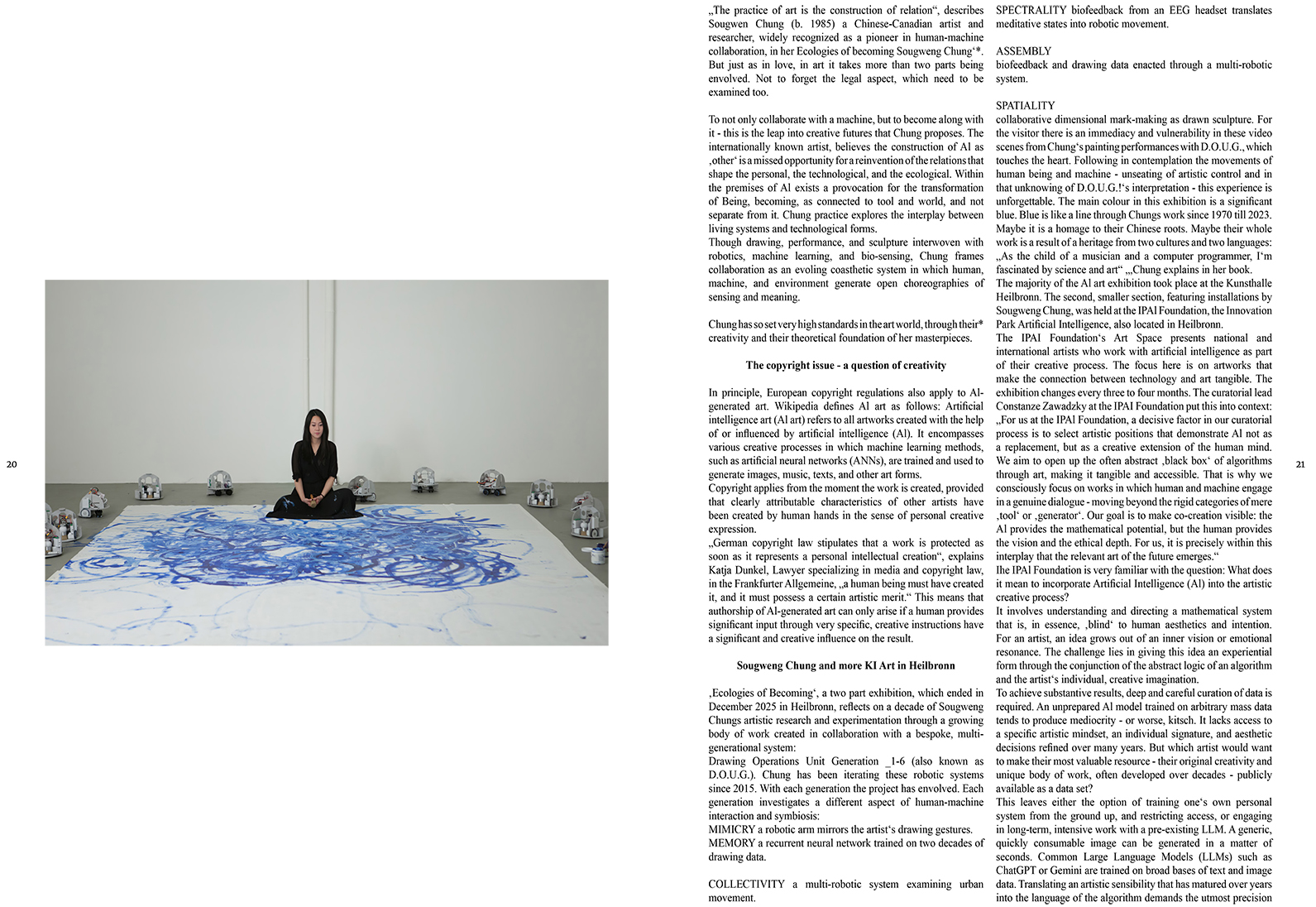
‚Ecologies of Becoming‘, a two part exhibition, which ended in December 2025 in Heilbronn, reflects on a decade of Sougweng Chungs artistic research and experimentation through a growing body of work created in collaboration with a bespoke, multi-generational system:
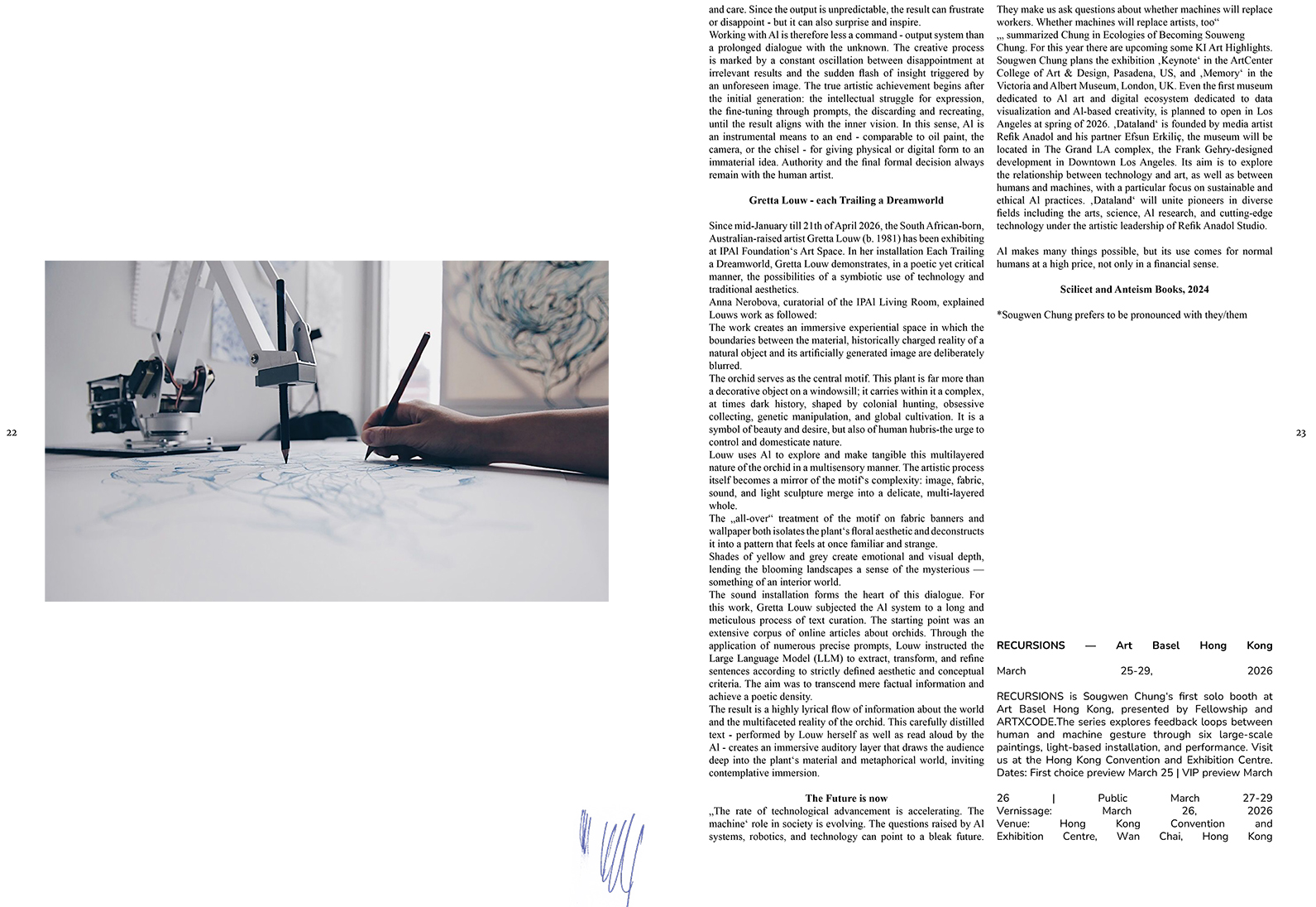
Drawing Operations Unit Generation _1-6 (also known as D.O.U.G.). Chung has been iterating these robotic systems since 2015. With each generation the project has envolved. Each generation investigates a different aspect of human-machine interaction and symbiosis:
MIMICRY a robotic arm mirrors the artist’s drawing gestures.
MEMORY a recurrent neural network trained on two decades of drawing data.
COLLECTIVITY a multi-robotic system examining urban movement.
SPECTRALITY biofeedback from an EEG headset translates meditative states into robotic
movement.
ASSEMBLY
biofeedback and drawing data enacted through a multi-robotic system.
SPATIALITY
collaborative dimensional mark-making as drawn sculpture.
For the visitor there is an immediacy and vulnerability in these video scenes from Chung’s painting performances with D.O.U.G., which touches the heart. Following in contemplation the movements of human being and machine – unseating of artistic control and in that unknowing of D.O.U.G.!’s interpretation – this experience is unforgettable. The main colour in this exhibition is a significant blue. Blue is like a line through Chungs work since 1970 till
2023. Maybe it is a homage to their Chinese roots. Maybe their whole work is a result of a heritage from two cultures and two languages: „As the child of a musician and a computer programmer, I’m fascinated by science and art“
„, Chung explains in her book.
The majority of the Al art exhibition took place at the Kunsthalle Heilbronn. The second, smaller section, featuring installations by Sougweng Chung, was held at the IPAl Foundation, the Innovation Park Artificial Intelligence, also located in Heilbronn.
The IPAI Foundation’s Art Space presents national and international artists who work with artificial intelligence as part of their creative process. The focus here is on artworks that make the connection between technology and art tangible. The exhibition changes every three to four months. The curatorial lead Constanze Zawadzky at the IPAI Foundation put this into context: „For us at the IPAl Foundation, a decisive factor in our curatorial process is to select artistic positions that demonstrate Al not as a replacement, but as a creative extension of the human mind. We aim to open up the often abstract ‚black box‘ of algorithms through art, making it tangible and accessible. That is why we consciously focus on works in which human and machine engage in a genuine dialogue – moving beyond the rigid categories of mere ‚tool‘ or ‚generator‘. Our goal is to make co-creation visible: the Al provides the mathematical potential, but the human provides the vision and the ethical depth. For us, it is precisely within this interplay that the relevant art of the future emerges.“
Ihe IPAl Foundation is very familiar with the question: What does it mean to incorporate Artificial Intelligence (Al) into the artistic creative process?
It involves understanding and directing a mathematical system that is, in essence, ‚blind‘ to human aesthetics and intention. For an artist, an idea grows out of an inner vision or emotional resonance. The challenge lies in giving this idea an experiential form through the conjunction of the abstract logic of an algorithm and the artist’s individual, creative imagination.
To achieve substantive results, deep and careful curation of data is required. An unprepared Al model trained on arbitrary mass data tends to produce mediocrity – or worse, kitsch. It lacks access to a specific artistic mindset, an individual signature, and aesthetic decisions refined over many years. But which artist would want to make their most valuable resource – their original creativity and unique body of work, often developed over decades – publicly available as a data set?
This leaves either the option of training one’s own personal system from the ground up, and restricting access, or engaging in long-term, intensive work with a pre-existing LLM. A generic, quickly consumable image can be generated in a matter of seconds. Common Large Language Models (LLMs) such as ChatGPT or Gemini are trained on broad bases of text and image data. Translating an artistic sensibility that has matured over years into the language of the algorithm demands the utmost precision and care. Since the output is unpredictable, the result can frustrate or disappoint – but it can also surprise and inspire.
Working with Al is therefore less a command – output system than a prolonged dialogue with the unknown. The creative process is marked by a constant oscillation between disappointment at irrelevant results and the sudden flash of insight triggered by an unforeseen image. The true artistic achievement begins after the initial generation: the intellectual struggle for expression, the fine-tuning through prompts, the discarding and recreating, until the result aligns with the inner vision. In this sense, Al is an instrumental means to an end – comparable to oil paint, the camera, or the chisel – for giving physical or digital form to an immaterial idea. Authority and the final formal decision always remain with the human artist.
Gretta Louw – each Trailing a Dreamworld
Since mid-January till 21th of April 2026, the South African-born, Australian-raised artist Gretta Louw (b. 1981) has been exhibiting at IPAl Foundation’s Art Space. In her installation Each Trailing a Dreamworld, Gretta Louw demonstrates, in a poetic yet critical manner, the possibilities of a symbiotic use of technology and traditional aesthetics.
Anna Nerobova, curatorial of the IPAl Living Room, explained Louws work as followed:
The work creates an immersive experiential space in which the boundaries between the material, historically charged reality of a natural object and its artificially generated image are deliberately blurred.
The orchid serves as the central motif. This plant is far more than a decorative object on a windowsill; it carries within it a complex, at times dark history, shaped by colonial hunting, obsessive collecting, genetic manipulation, and global cultivation. It is a symbol of beauty and desire, but also of human hubris-the urge to control and domesticate nature.
Louw uses Al to explore and make tangible this multilayered nature of the orchid in a multisensory manner. The artistic process itself becomes a mirror of the motif’s complexity: image, fabric, sound, and light sculpture merge into a delicate, multi-layered whole.
The „all-over“ treatment of the motif on fabric banners and wallpaper both isolates the plant’s floral aesthetic and deconstructs it into a pattern that feels at once familiar and strange.
Shades of yellow and grey create emotional and visual depth, lending the blooming landscapes a sense of the mysterious —something of an interior world.
The sound installation forms the heart of this dialogue. For this work, Gretta Louw subjected the Al system to a long and meticulous process of text curation. The starting point was an extensive corpus of online articles about orchids. Through the application of numerous precise prompts, Louw instructed the Large Language Model (LLM) to extract, transform, and refine sentences according to strictly defined aesthetic and conceptual criteria. The aim was to transcend mere factual information and achieve a poetic density.
The result is a highly lyrical flow of information about the world and the multifaceted reality of the orchid. This carefully distilled text – performed by Louw herself as well as read aloud by the Al – creates an immersive auditory layer that draws the audience deep into the plant’s material and metaphorical world, inviting contemplative immersion.
The Future is now
„The rate of technological advancement is accelerating. The machine‘ role in society is evolving. The questions raised by Al systems, robotics, and technology can point to a bleak future. They make us ask questions about whether machines will replace workers. Whether machines will replace artists, too“
„, summarized Chung in Ecologies of Becoming Souweng
Chung.
For this year there are upcoming some KI Art Highlights. Sougwen Chung plans the exhibition
‚Keynote‘ in the ArtCenter College of Art & Design, Pasadena, US, and
‚Memory‘ in the Victoria and Albert Museum, London, UK.
Even the first museum dedicated to Al art and digital ecosystem dedicated to data visualization and Al-based creativity, is planned to open in Los Angeles at spring of 2026.
‚Dataland‘ is founded by media artist Refik Anadol and his partner Efsun Erkiliç, the museum will be located in The Grand LA complex, the Frank Gehry-designed development in Downtown Los Angeles. Its aim is to explore the relationship between technology and art, as well as between humans and machines, with a particular focus on sustainable and ethical Al practices. ‚Dataland‘ will unite pioneers in diverse fields including the arts, science, Al research, and cutting-edge technology under the artistic leadership of Refik Anadol Studio.
Al makes many things possible, but its use comes for normal humans at a high price, not only in a financial sense.
Scilicet and Anteism Books, 2024
* Sougwen Chung prefers to be pronounced with they/them